
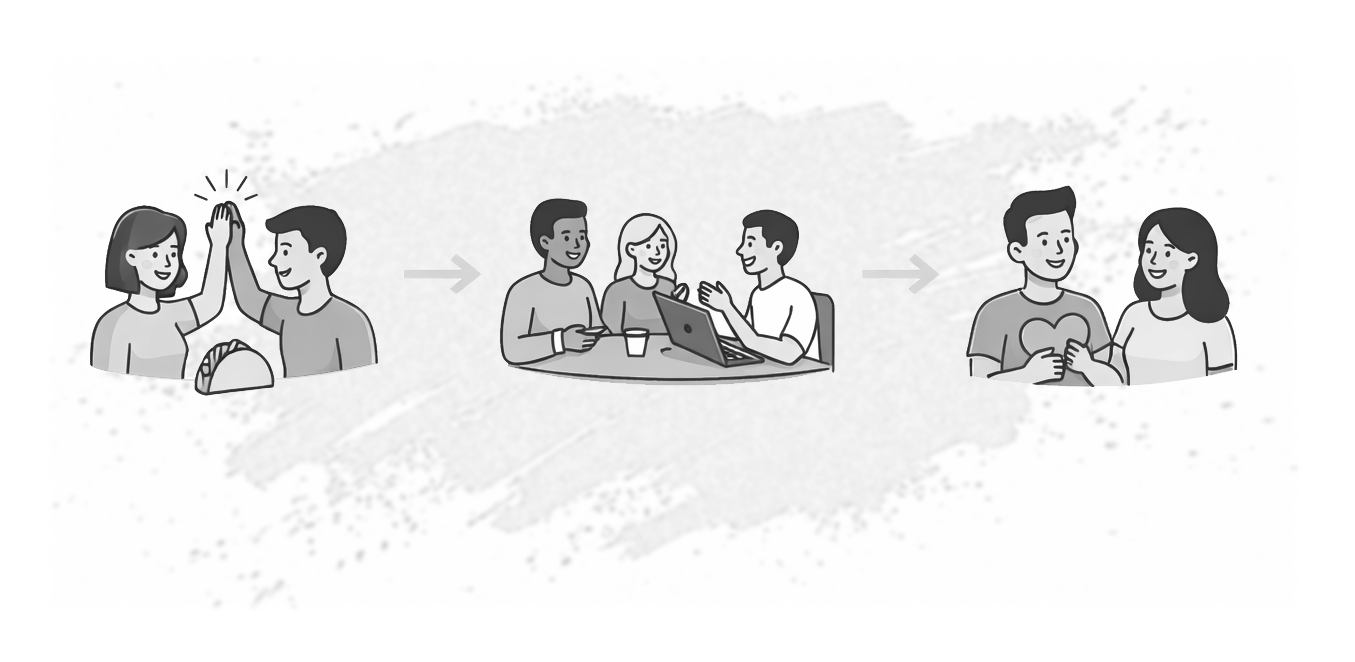
TL;DR: Company Culture
- Company culture is made up of the beliefs, values, attitudes, and behaviors.
- Leadership and employees share the responsibility for building company culture.
- Rituals, recognition, and authenticity are a few ways to create a positive workplace culture.
In this guide
- What is company culture?
- What is employee experience?
- How does leadership impact company culture?
- How do employees impact company culture?
- Real-life company culture examples
- How recognition became the core of Centime's company culture
- What makes a strong workplace culture?
- 12 ways to improve company culture (remote and budget-friendly)
- A Theory of Change: Targeting behaviors to improve company culture
- Build a culture of recognition with something small: HeyTaco 🌮
- Company culture FAQ
What is company culture?
Company culture is made up of an organization's shared beliefs, values, attitudes, and behaviors. It shapes how everyone interacts and collaborates at work.
- Beliefs. "We believe everyone should be treated with respect."
- Values. "Adaptability is a core value. It's good to think on your feet and embrace change."
- Attitudes. "We don't blame others or get stuck on failure here. Challenges are opportunities to grow."
- Behaviors. "Every Friday, we eat lunch together and talk about the week, even if it's over Teams. This week we're also doing Show-and-Tell with our sandwiches."
Notice that all but one of these are ideas, not actions. As you've likely experienced, what a company claims is important versus how it actually behaves can be quite different.
That's why company culture will never be the words leadership decides to put on a page. It's what people experience working inside the organization.
What is employee experience?
Employee experience encompasses how employees think, feel, hear, and see at their workplace. It's their assessment of company procedure, from onboarding to performance reviews. Experience can even be how they feel when they wake up for work in the morning.
Most importantly, it's every interaction they have. A strong company culture is the best way to shape the employee experience. When those negative interactions inevitably occur, they'll have a weaker influence on overall employee engagement, motivation, and morale.
How does leadership impact company culture?
Company culture cannot be HR's responsibility alone. Managers and leaders across the board impact the culture in the following ways:
- Values and vision. This is what makes employees feel like they have a purpose. Core values and a vision for the company create the desired undertones for the culture.
- Modeling the behaviors. Employees will not buy into beliefs and attitudes if their leader's daily actions don't reflect them.
- Structure and policy. Policy has to align with the values and behaviors the company wants to perpetuate. Structure has sway over the employee experience.
Ultimately, leaders must be seen as strong advocates for all of the positives that come with working at their organization.
🤝 Share responsibility. Employees play a role, but only leaders can lay the foundation for the culture that serves their business goals. Read more about leadership ownership in company culture.
How do employees impact company culture?
Leadership plants the seeds; employees help care for the plant. But it's not just about growth. Employee ownership in company cultures is what makes them authentic.
- Rituals and traditions. How everyone celebrates, helps one another, and sparks motivation will largely be sustained by employees.
- Social norms and peer relations. There's a collective mood more often than not. This can impact behaviors and attitudes as much as leadership, if not more.
- Exchanging feedback. Give employees a say, and it becomes evident which branches and leaves need to be pruned away. This keeps culture fresh and relevant.
An employee-driven culture helps tailor the environment to their needs. This is a plus for engagement and productivity.
“Fostering a thriving company culture is not about who wields control but how leaders and employees come together to forge something meaningful and enduring.”
Doug Dosberg, Founder of HeyTaco
Real-life company culture examples
If we distill the definition of company culture, it's words plus action, and everyone has a role to play. Here's a glimpse into how hugely successful companies approach culture.
Costco: America's best employer?
Most people know that Costco compensates above and beyond the average retailer. It isn't just about paychecks, though. It's about flexibility, recognition, and respect. Employees get treated as well as customers. As their CEO famously remarked, “Culture isn't the most important thing — it's the only thing.”
What's in it for Costco? For starters, their retention rates remain above 90%. That's 30% or more above retailers like Walmart.
Zappos: Where growth isn't too grown up.
The culture at Zappos is so notorious that there's a dedicated initiation to it during onboarding. With at least 10 core values to uphold, fun activities abound to keep everyone dialed in. Employees find it's a great complement to the clear communication and comprehensive training they receive.
So, is the secret to better customer service giving employees more ping-pong, pizza, and PTO? It definitely helps. Zappos' retention rates are significantly higher than those of a typical call center.
Adobe: Co-creating an empowering community.
Adobe underwent quite a cultural shift just a few years ago. Employee feedback and leadership buy-in became the top priority. Today, the culture is widely regarded as forgiving but also honest. Inclusivity and acceptance are making their employees more willing to innovate.
Simple, respectful considerations like scheduling meetings around time zones are important. As a result, their retention rates now remain at or above 90%, 5-10% ahead of their industry average.
📖 Linking words with actions. Read more real-life examples and see how values become behaviors. It's broken down further in this post on how the best workplaces do company culture right.
How recognition became the core of Centime's company culture
Fintech enterprise Centime did something that'll sound familiar to many. Understanding the importance of appreciation in company culture, they started using a recognition platform. Soon, everyone was getting monthly points that could be exchanged for gift cards.
With that, their culture of appreciation was complete. They lived happily ever after.
Ha! What actually happened was that the platform mostly went unused until the month was almost up. Then everyone would start throwing points around in a bid to get that gift card.
You can't really blame them. The method wasn't integrated into employee workflows, and the whole purpose of the thing was transactional. “Be nice online a few days of the month, and you will get $25 toward your next DoorDash order.” At least they were helping each other get the gift cards.
Fortunately, Centime's Chief Revenue Officer had some prior experience with HeyTaco. She knew it was more about gratitude and less about gift cards. Moreover, it could be integrated into workflows. This new recognition tool took up residence in an existing chat dedicated to work achievements. People are now personalizing messages, cheering one another on, and sharing positive affirmations.
There are still rewards to look forward to. People earn days off and fun experiences for the team to share together. Meaningful, non-monetary rewards that actually saved Centime money.
Employees at all levels adopt it. Engagement enjoys a noticeable boost. Most importantly, people use it to celebrate one another daily–not just a few days of the month. Those are values turned into action. THAT is culture.
What makes a strong workplace culture?
Every organization can take specific actions to strengthen its culture. Whether or not you get the ideas and tools from HeyTaco, any changes or initiatives should lend themselves to one of the following categories.
- Connection. Making people feel like they're working for more than just themselves.
- Recognition. Acknowledgment and praise reinforce the behaviors that make the culture what it is.
- Trust. Collaborating, offering feedback, and being honest isn't risky within a strong culture.
- Consistency. Everyone slips up, but there should be no glaring contradictions between words and actions.
- Clarity. Employees understand what the organization stands for and what success looks like.
12 ways to improve company culture (remote and budget-friendly)
Want to be who you say you are? The following behaviors are common in the best company cultures. They're all free and easy to execute in virtual environments. It's a companywide commitment that makes them work.
1. Before anything, define your core values.
Inclusion, courage, diversity of thought. Think about your long-term goals. Engage your team (the way Adobe did), and be honest about which words truly reflect the organization.
🧭 What are your guiding principles? Check out our list of 100 core value examples and choose a few that you'd like to see influence daily operations and experiences.
2. Find your core values.
Spotting value-driven behaviors in the wild helps employees identify more of them, in addition to reinforcing the behavior. A feature like Taco Tags gets the point across and makes it easy for others to join in.
3. Create rituals.
Rituals give employees an identity at work, increasing belonging. When people feel they belong, they're less prone to burnout because there's a general sense they have community support.
🛠️ Let's build a ritual this week. Team rituals are the easiest way to get people to repeat positive behaviors. We have research, tips for success, and plenty of ideas in our guide to team rituals.
4. Share credit.
A culture-killer people don't discuss enough is a sense of injustice. We usually think of unfairness in terms of favoritism, but more often, it's feeling like your contributions weren't sufficiently acknowledged.
5. Make purpose at least as important as performance.
Which sounds like a more meaningful job? Needing to make 20 tacos by 2 pm (or ELSE)? Or, delivering the best tacos you can to people who haven't eaten all day and are really looking forward to what you bring?
6. Celebrate often.
Small, low-pressure celebrations have been proven more effective than those requiring budget and planning. Carve out a few minutes, a few times a week, to cheer about the tiniest wins.
7. Improve communication.
People cannot act on values, expectations, or beliefs if they're unsure of what those values, expectations, or beliefs are. Refine these ideas and ensure everyone's clear on them first.
💻 Remote reminder. Fully remote employees may need twice the base-touching others do. That's just one of 10 recognition-forward ways to improve workplace communication.
8. Respect their time and space.
Setting and acknowledging boundaries go hand-in-hand with better communication. When employees feel like it's okay to say no to something outside of their responsibilities or working hours, that's a good sign.
9. Loosen up during 1:1s.
The best managers and leaders know it's good to get vulnerable at times. This behavior is far more effective and authentic if you have a genuine rapport with each individual. Make at least some of those 1:1s feel like an informal chat with some non-work topics included.
10. Exercise empathy.
When the heat is on, what does it really look like to be empathetic toward employees? It means hearing them out when they're upset, and not interrupting. It's encouraging them to use their PTO with no guilt trips.
11. Allow employees control.
Permitting employees to steer the boat gives companies some hands-off time to let the culture happen. Giving employees choices and bringing them in on decisions eliminates feelings of helplessness that lead to disengagement.
12. Increase positive interactions.
A cheerful “Good morning!” is a great place to start. Celebrating small wins and making gratitude habitual are key ways to bump up the positivity numbers. Peer recognition and peer-directed rituals will take it even further.
🔍 Want more details? Find deeper explanations for many of these actions with 13 worthwhile ways to improve company culture.
A Theory of Change: Targeting behaviors to improve company culture
Examples of positive company culture seem like a fantasy for some organizations. When there's a lot of change to be made, they try to implement too many ideas at once. It's an effort so scattered that its impact is very limited.
The answer to this overwhelm is to start small and with intention. Harvard University and a behavioral science practice created a four-step model for targeting and addressing the behaviors that truly change company culture.
Below is an adapted example to help show how you can use it with your own teams. Harvard used this model to increase diversity at a global company. Our process breaks down peer recognition to improve the team bonds that make up the culture.
| STEP 1: Target one behavior. Explain the problem. Drill down on a single behavior that could make a measurable improvement in the area you're looking to change. | Rituals and celebrations aren't benefiting the culture because employees don't seem to have a team connection. It feels as though they're going through the motions or participating out of obligation. Team-building exercises are awkward, and celebrations go quiet quickly. It's hypothesized that if employees had more low-pressure, informal interactions, they'd gradually build organic connections among one another. This could increase the participation in and impact of company-led, culture-centric activities. Therefore, the one behavior we want to target is daily peer interactions. |
| STEP 2: Create a Theory of Change. What is holding people back from this behavior? Is there any research or data suggesting a fix? | The majority of the employees are remote. They're responsive and productive, but busy. Their roles don't involve much collaboration. A number of studies and surveys show that peer recognition assists with group affiliation and helping behaviors. Research also reveals that the most essential way to get isolated workers to participate in recognition programs is to ensure tools are integrated into their workflow. |
| STEP 3: Present your solution. Timeliness is most important here. The solution must be available at the moment people need it. | Introducing a peer recognition tool that integrates into existing communication channels. Verbal and written suggestions and instructions are distributed in the week leading up to launch. Managers are first to use the tool on launch day, modeling its use for all behaviors that align with core values and general praise. A few team members adopt quickly, using the tool daily to thank team leads and coworkers. At one week, leaders use it to celebrate an employee's work anniversary. Roughly 87% of employees chime in on their own, using the tool to send congratulations to their coworker. At two and a half weeks, a separate channel is made expressly for water cooler-style discussion, help requests, and the gratitude that results from these interactions. |
| STEP 4: Measure your results. What has changed? Where is the impact most evident? | Participation in team and culture events rose 25% over 30 days. Similar rises in overall job satisfaction are present in survey responses. Leadership is exploring more peer-centric initiatives, such as cross-department collaborations for certain projects. |
Build a culture of recognition with something small: HeyTaco 🌮
How could virtual tacos possibly be the building blocks of a better employee experience? Here's how HeyTaco improves company culture:
1. It makes small peer interactions more gratifying.
In a short amount of time, people start seeking tiny, meaningful reasons to praise one another. The number of positive exchanges among coworkers increases without any formal or complex processes.
2. It introduces an element of gamification (aka FUN).
Optional leaderboard visibility keeps everyone up to date on taco-giving activity. This can spark friendly competition, sure. It can also keep them up to date on their progress toward a team goal.
3. It's a springboard for culturally relevant team rituals.
Taco plushies, real taco lunches, and other taco-themed events. We've seen the small but mighty taco become a cultural symbol of appreciation and fun all over the world. Plus, with Taco Tags, it can be directly tied to core values.
4. It's sustainable and scalable.
Too many cultures depend on that one enthusiastic leader or always-cheerful employee. Peer recognition with HeyTaco happens daily, gradually and naturally building connections across the entire team.
Start for free this week!
Frequently Asked Questions
What are signs of a healthy work culture?
High engagement, clear expectations, and attention to everyone's well-being and inclusion are the biggest indicators of a strong, healthy workplace culture.
Sharing values and excelling at collaboration improve the longevity of such a culture.
What are examples of bad work culture?
Culture influences engagement, retention, collaboration, and performance. Employees are more likely to contribute fully when they feel valued and connected.
How do you improve workplace culture?
Bad or lacking company culture looks like this:
- No values, or having leaders who do not adhere to values
- High absentee rates and stressed employees
- People leaving within a few months of onboarding
- Rumors, gossip, and people divided into cliques
What are the 4 types of company culture?
A lot of organizations fit into one or more of these four cultures:
- Creative: Growth and innovation. Employees are encouraged to improve processes and share ideas.
- Clan: Community and team cohesion. Coworker bonds and shared purpose are key to daily work.
- Hierarchy: Top-down leadership. Decision-making and responsibilities are determined by rank.
- Market: Corporate and results-driven. Competitive and prone to performance pressure.
These categories are only one school of thought, and one that may be outdated. The most successful company cultures are always building, tailoring to their people and purpose.
For instance, many workplaces with a set hierarchy evolve to better support creativity and team bonds. Many clan-style cultures take hints from creative cultures to avoid groupthink.
What is a positive workplace culture?
Positive company cultures rely on trust and respect more than smiles. Employers trust their people to meet an objective without micromanaging them. Employees feel their employer respects them as both a contributor and a human.
These factors are what lie behind mutual satisfaction with the working relationship, feeling valued and appreciated.