
TL;DR: Employee Incentive Programs
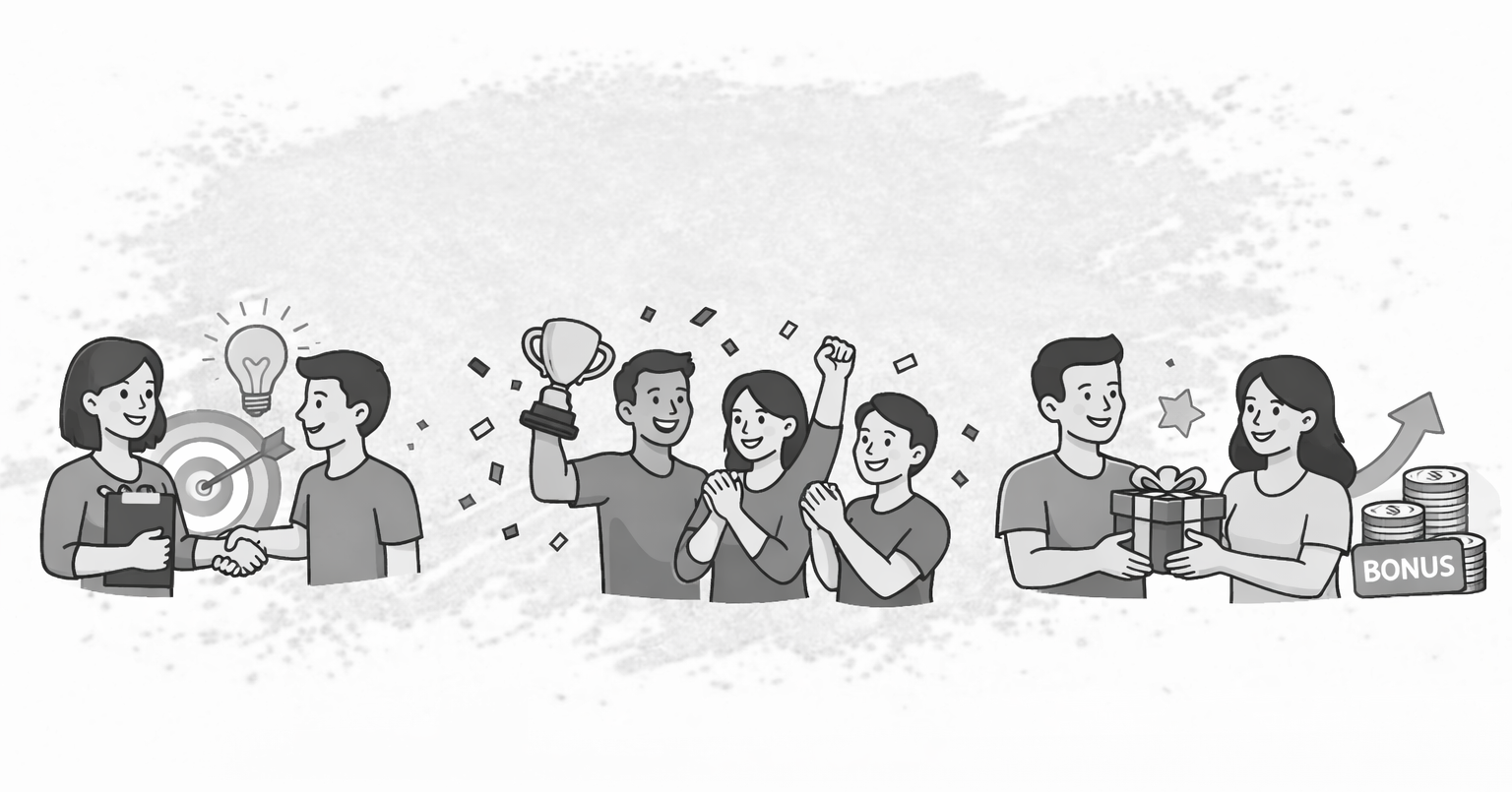
- An incentive program names a goal in advance and rewards people for reaching it.
- Most programs only reward big results a few times a year. Everyday incentives reward the steps in between.
- The strongest programs pair incentives with recognition, so rewards feel earned and public, not transactional.
In this guide
- What is an employee incentive program?
- Incentives vs. recognition vs. rewards
- Types of employee incentive programs
- Why everyday incentives matter
- How to build an employee incentive program in 6 steps
- What HeyTaco teams actually reward
- Employee incentive ideas by team
- Common incentive program mistakes to avoid
- How to measure your incentive program
- Run everyday incentives in Slack with HeyTaco Quests
- Employee incentive program FAQ
What is an employee incentive program?
💡 An employee incentive program is a structured way to reward specific behaviors or results you want more of. You name the goal in advance, set the reward, and decide how people qualify.
Here's what HR pros, people leaders, and managers need to know about incentives:
- They're about specific behaviors. "Do great work" isn't an incentive. "Book five demos this week" is. People need to know exactly what to go after.
- The reward is only part of it. In a study from the Incentive Research Foundation, 40% to 50% of what employees wanted from an award had nothing to do with the reward itself. Who presents it, how it's announced, and what it means for their career mattered just as much.
- Frequency matters as much as size. A small reward people can earn every week keeps them moving in a way a once-a-year bonus can't.
Incentives vs. recognition vs. rewards
These three terms get used interchangeably, but they do different jobs. The strongest programs use all three together.
| Incentives | Recognition | Rewards | |
|---|---|---|---|
| Timing | Set before the work | Given after the work | Redeemed whenever |
| What it says | "Do this, and you'll earn that" | "I saw what you did" | "Here's something tangible" |
| Who drives it | Usually managers or admins | Anyone, peer to peer | The person who earned it |
| Example | 10 tacos for booking 5 demos this week | A teammate thanks you in Slack for a save | Trading tacos for a gift card |
Incentives point effort at a goal. Recognition makes people feel seen. Rewards make both of them tangible.
On their own, incentives can feel transactional. That's why one-off cash incentives rarely fix bigger problems like retention. People stay where they feel valued every day, not where they're paid once a quarter to hit a number.
🤝 Incentives work best alongside recognition. Our guides to employee recognition and employee retention cover the other half of the picture.
Types of employee incentive programs
Most programs mix several of these. The right blend depends on what you're trying to change, your budget, and how often you want people to have something to chase.
| Type | Examples | Works well for | Watch out for |
|---|---|---|---|
| Cash bonuses and commissions | Quarterly bonus, sales commission, profit sharing | Big, measurable results | Expensive, infrequent, and easy to see as part of pay |
| Spot bonuses | A one-time payment for a specific win | Rewarding a moment quickly | Can feel arbitrary without clear criteria |
| Points-based programs | Points or tacos redeemed for gift cards and rewards | Frequent, smaller behaviors | Points need real value, or nobody chases them |
| Contests and challenges | Sales contests, step challenges, short sprints | Creating energy around one goal for a set time | Rewarding the same top performers every time |
| Time off and experiences | An extra day off, team outings, event tickets | High perceived value without cash | Harder to scale and schedule |
| Learning and development | Course budgets, certification rewards | Building skills the business needs | Slow payoff, so pair it with a visible reward |
| Peer-nominated awards | Teammates nominate someone who went above and beyond | Catching work managers don't see | Popularity contests without approval or criteria |
Is cash always the best incentive?
Not necessarily. Ask people directly and many will say they want cash. But when the whole experience is right, the Incentive Research Foundation found that 65% of people would choose a non-cash award instead. Non-cash rewards are easier to talk about, show off, and remember, and they're less likely to blur into regular pay.
🧮 Points only work if they're worth something. Use HeyTaco's Taco Value Calculator to figure out what a taco should be worth for your team.
Why everyday incentives matter
Most incentive programs are built around a few big moments a year. Bonuses land at the end of the quarter. Commissions arrive after the deal closes. Annual awards happen once.
That leaves a long stretch where people do the work with nothing to show for it. A rep books demo after demo in a slow month. An engineer fixes the flaky build nobody owns. A new hire's buddy spends hours getting them up to speed. None of it shows up in the bonus calculation.
"Bonuses tell people what mattered last quarter. Everyday incentives tell them what matters this week."
Doug Dosberg, Founder of HeyTaco
Everyday incentives fill that gap. They're smaller, more frequent rewards for the actions that lead to results:
- Big incentives reward outcomes, a few times a year, usually from a manager.
- Everyday incentives reward the steps, every week, often in front of the whole team.
They don't replace bonuses. They make the time between them count. And because they happen in public, they double as recognition: everyone sees what's being rewarded and why.
How to build an employee incentive program in 6 steps
You don't need a big budget or a new HR system to start. You need a few clear goals, a fair way to reward them, and a place where people will actually see them.
1. Pick the behaviors, not just the results.
Start with two or three things you want more of right now. For each outcome you care about, ask what people do every week that leads to it. "Hit quota" is the outcome. "Book five demos" is the behavior that gets you there.
2. Make each one easy to prove.
If you can't tell whether someone did it, people won't trust the program. Ask for a link, a screenshot, or a one-line note. Decide upfront whether a manager approves each submission or whether it's automatic.
3. Set rewards on a consistent scale.
Match the reward to the effort. Quick actions earn a little, meaningful work earns more, and big wins earn the most. Consistency matters more than the exact numbers, because people compare.
🗺️ Don't start from a blank page. The Quests Library has 58 incentive ideas from real teams, each with a suggested reward and settings you can copy.
4. Add guardrails.
Cap how often someone can earn each incentive. Set start and end dates for time-boxed challenges. Require approval for anything high-value. Guardrails keep the program fair and your budget predictable.
5. Launch it where people already work.
An incentive buried in an HR portal gets forgotten. Announce it in the channels your team uses every day, and celebrate completions in public so others see what's possible.
6. Review and refresh every quarter.
Retire incentives nobody uses. Raise or lower rewards that feel off. Add new ones as priorities change. A program that never changes fades into the background.
What HeyTaco teams actually reward
When HeyTaco teams set up incentives with Quests, the most popular ones aren't about sales numbers. They reward people helping people.
These are the most-launched Quest templates in the Quests Library:
The pattern is clear. Teams use incentives to reward the work that never shows up in a performance review. Mentoring, rescuing a teammate, and welcoming new hires matter to every team, but they're rarely anyone's official goal. An incentive makes them visible.
Employee incentive ideas by team
Every team has work worth rewarding. Start with one or two ideas from your area, then add more once people get the hang of it.
Sales
Reward the activity that fills the pipeline, not just the deals that close it.
- Book five demos in a week
- Close a new customer
- Beat your personal best
- Share a winning call recording with the team
Customer support
Support wins often stay hidden in the queue. Incentives bring them into the open.
- Hit your CSAT goal
- Get called out by name in five-star feedback
- Write a help article
- Clear the weekend queue
Engineering
The most valuable engineering work is often the least visible.
- Ship something meaningful
- Clear a blocker from the last retro
- Document something that only lives in someone's head
- Call for backup early when you're on call
People and HR
Everyone can help hire, onboard, and grow the team.
- Refer a great hire
- Welcome a new teammate
- Mentor someone
- Host a lunch and learn
Operations and safety
Reward the behaviors that keep people safe, never the absence of reported incidents.
- Complete safety training
- Report a near miss
- Suggest a process fix
- Remove an unnecessary step
🗺️ Want the full list? Browse 58 ready-to-use ideas in the Quests Library, each with a suggested reward, settings, and copy you can paste in.
Common incentive program mistakes to avoid
Most incentive programs don't fail all at once. They fade because of a few small design choices. Watch out for:
- Rewarding only the final number. If the only incentive is hitting quota, people who fall behind early have nothing to work toward for the rest of the quarter. Reward the steps too.
- Rewarding the absence of problems. Incentives for "zero incidents" or "no complaints" can push people to stop reporting them. OSHA has warned that incentive programs which discourage injury reporting can violate workers' legal protections. Reward the behavior you want instead, like reporting a near miss.
- Inconsistent rewards. If closing a deal earns less than tidying the kitchen, people notice and stop taking the program seriously. Use one scale across every incentive.
- Rewards nobody wants. Points people can't spend aren't an incentive. Preferences vary a lot, too: in the IRF study, 99% of respondents had a unique set of reward preferences. Let people choose what they redeem for.
- Only rewarding individuals. Shared goals depend on everyone. Mix in team incentives so people help each other instead of competing for credit.
- Keeping it private. An incentive only one manager knows about can't change behavior across a team. Announce what's on offer and celebrate when someone earns it.
- Set-it-and-forget-it. The same incentives running for a year become invisible. Refresh them every quarter.
How to measure your incentive program
You don't need a dashboard to start. Once a month, take a quick look at five things:
- Participation. How many people earned at least one incentive? If it's low, simplify the criteria or launch one easy, fun incentive to get people started.
- Spread. Are rewards going to many people or the same few? If it's the same few, add team incentives and behaviors anyone can do.
- The target behavior. Did the thing you rewarded actually increase? More demos booked, more docs written, more near misses reported. If not, the reward may be too small or the proof too much work.
- Redemption. Are people spending what they earn? If rewards sit unused, add options people actually want.
- Freshness. When did you last add or retire an incentive? If it's been more than a quarter, it's time for a refresh.
🌮 Already using HeyTaco? Take the Taco Economy assessment to see how healthy your taco economy is.
Run everyday incentives in Slack with HeyTaco Quests
Big incentives take time to design, approve, and pay out. Everyday incentives can start next week.
Quests are the everyday layer of your incentive program, built right into Slack. Admins create a Quest around any goal and set a taco reward. Teammates complete it themselves or nominate someone who did. Once it's approved, tacos land in their balance, ready to trade for gift cards and rewards.
Teams use HeyTaco Quests to:
- Reward the steps toward big goals, every week
- Make invisible work like mentoring and onboarding visible
- Keep rewards fair with proof, approvals, and limits
- Celebrate wins in Slack, so incentives double as recognition
Start from 58 templates in the Quests Library or create your own. Quests are included on every plan. Learn how Quests work.
Employee incentive program FAQ
What is an example of an employee incentive program?
A sales team might pay quarterly commission on closed deals, plus a weekly incentive for booking five demos. The commission rewards the result; the weekly incentive rewards the activity that leads to it.
What are the most common types of employee incentives?
Cash bonuses and commissions, spot bonuses, points-based rewards, contests, time off and experiences, learning budgets, and peer-nominated awards. Most programs combine several.
How do I incentivize employees without big bonuses?
Use small, frequent rewards tied to specific actions. Points or tacos that turn into gift cards, extra time off, and public recognition all work. Frequency matters more than size.
How much should an employee incentive be worth?
Match the reward to the effort. Quick actions earn a small reward, meaningful work earns more, and big wins earn the most. Keep the scale consistent so people trust it.
What's the difference between incentives and recognition?
Incentives are promised before the work, so people know what to aim for. Recognition comes after, when someone notices what you did. Strong programs use both.
How often should I change my incentive program?
Review it every quarter. Retire incentives nobody uses, adjust rewards that feel off, and add new ones as priorities change.
Do non-cash incentives work as well as cash?
Often, yes. When the whole award experience is right, research from the Incentive Research Foundation found that 65% of people would choose a non-cash award over cash. How the reward is presented matters almost as much as the reward itself.
 Add to Slack