Most recognition leaderboards rank people by how much recognition they receive. Our data suggests that's the wrong thing to rank.
After ten years of building HeyTaco, we wanted to understand why some recognition programs become part of a team's culture while others slowly disappear.
So we studied it.
We worked with three independent researchers — Dr. Ewelina Forker of the Wisconsin School of Business, Dr. Adam Presslee of the University of Waterloo, and Dr. Alex Vandenberg of the University of Illinois — to analyze eight years of behavioral data from more than 5,000 teams.
We also surveyed 279 administrators across 232 organizations about what they actually do to keep recognition going.
A few patterns stood out. Teams recognize each other more when they highlight giving, not receiving. Rewards can increase participation rather than undermine it. And surprisingly small increases in recognition are associated with much stronger long-term adoption.
So if you're trying to create a kudos program in Slack, the mechanics are easy. Keeping people using it is the interesting part.
How do you give kudos in Slack?
There are three common ways to give kudos in Slack:
- Emoji reactions. They're free, fast, and already built into Slack. The downside is that recognition can disappear inside busy channels and threads, and there's no easy way to see participation over time.
- A #kudos channel. Create a dedicated channel where people publicly thank coworkers. It's simple and gives recognition a visible home, but someone usually needs to keep the habit alive.
- A recognition app. Tools like HeyTaco let people give visible peer recognition inside Slack, track participation over time, and add things like leaderboards and rewards.
Any of these can work. What determines whether people are still participating six or twelve months later comes down to a few design choices most teams don't think about.
Ready to make appreciation an everyday habit?
Try HeyTaco free for 30 days. No credit card required.
Try HeyTaco freeWhat makes a Slack kudos program work?
Celebrate giving, not receiving
This was one of the clearest findings in our research.
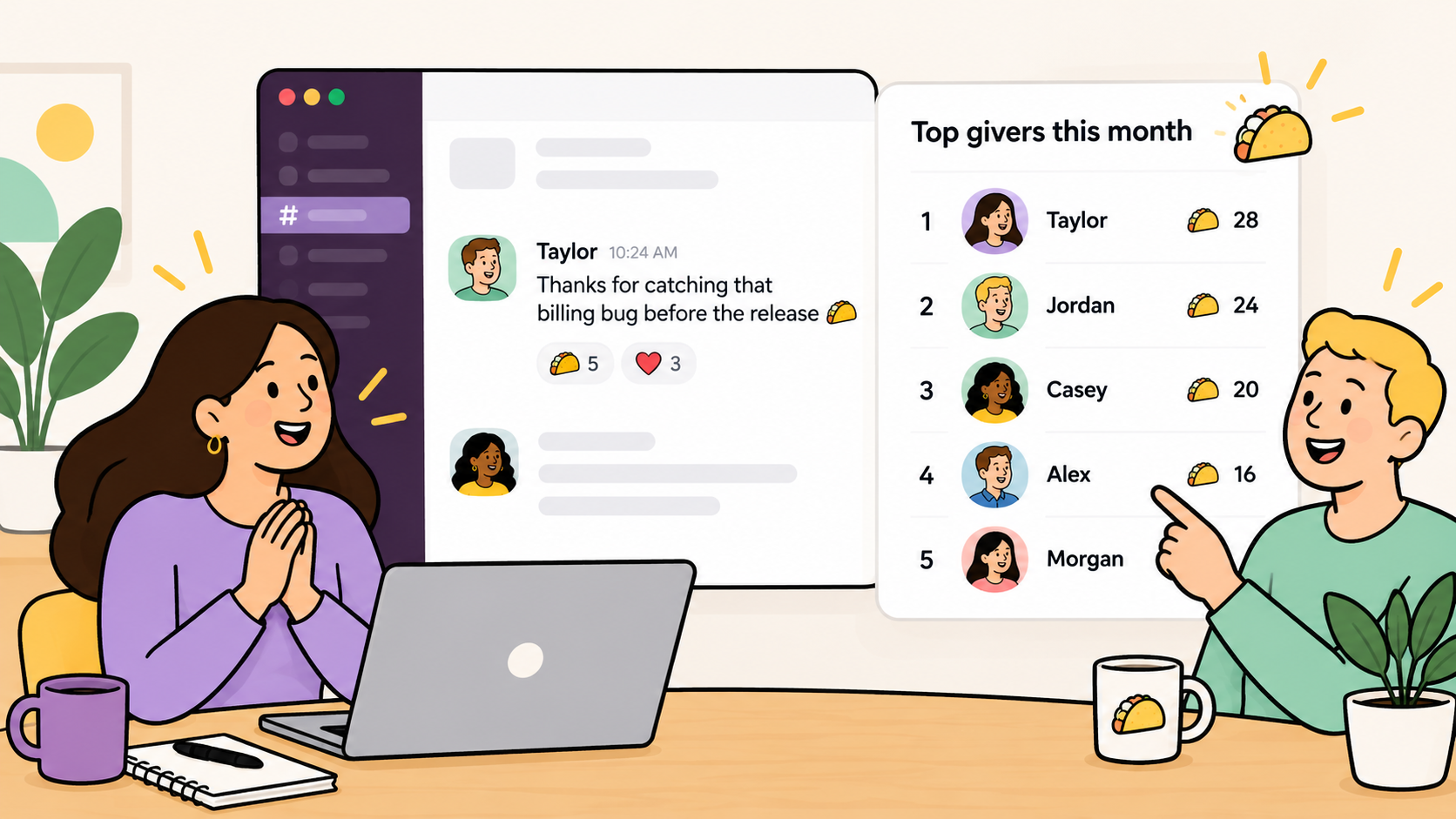
Teams that showed only a giving leaderboard gave 25% more recognition per person each month than teams with no leaderboard. They were also 57% more likely to keep using the recognition system over time. But when teams displayed both giving and receiving leaderboards, recognition activity was 23% lower than on teams showing giving alone.
That's an important distinction. Ranking people by how much appreciation they receive can turn recognition into a popularity contest. Ranking people by how much appreciation they give encourages the behavior you actually want more of.
That's why HeyTaco shows the giving leaderboard by default. The goal isn't to determine who's the most appreciated person in the company. It's to encourage more people to notice each other.
Rewards can increase recognition
There's a long-running argument that attaching rewards to recognition makes appreciation feel transactional. Our data suggests it's more nuanced than that.
Teams with rewards enabled saw 80% more recognition activity. They were also 481% more likely to adopt recognition across the whole organization.
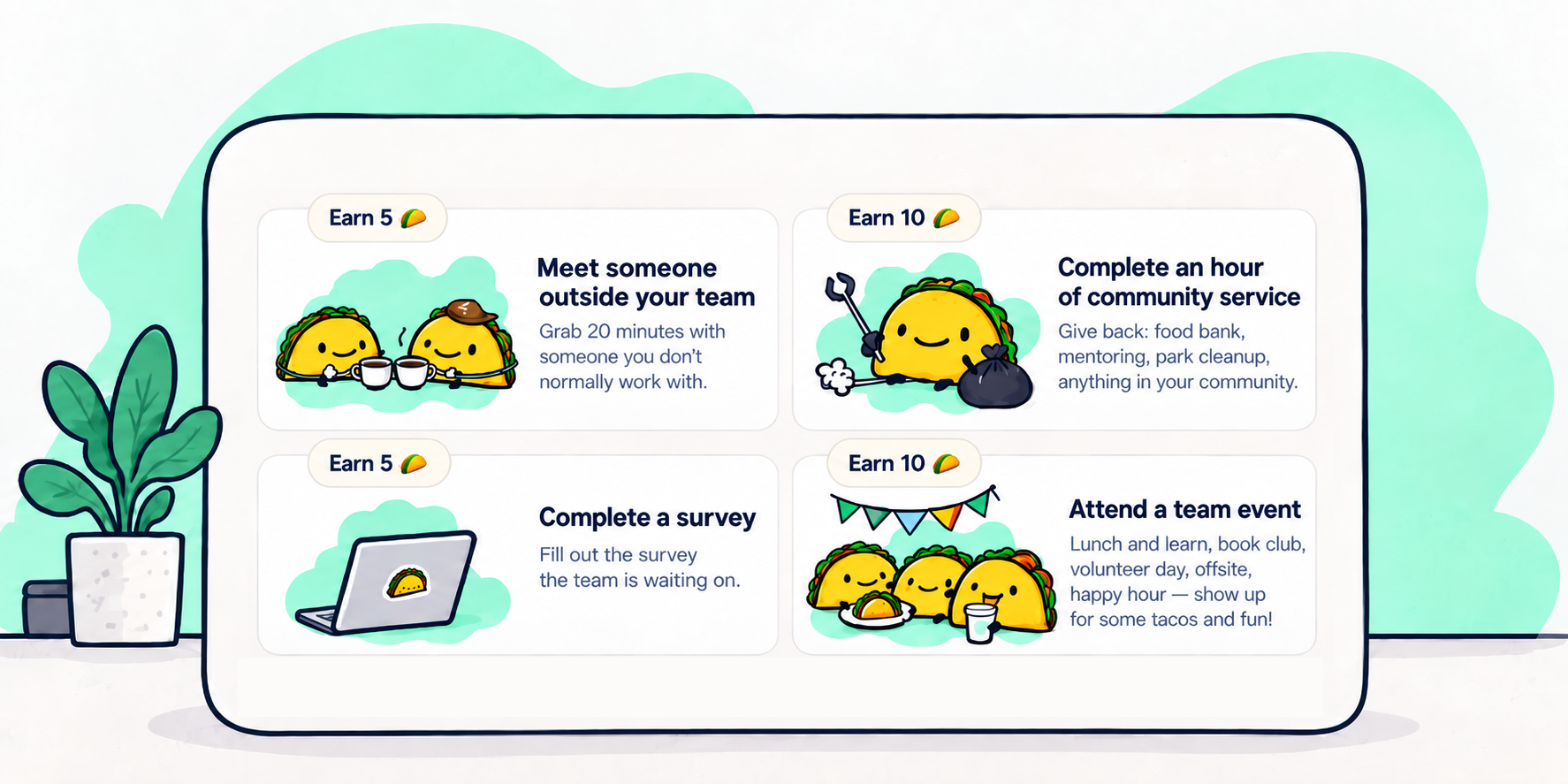
The important part is how the reward is framed. A gift card, team lunch, company swag, charitable donation, or other reward can reinforce participation without becoming the reason people recognize each other in the first place.
The recognition still needs to feel human. The reward is the bonus, not the point.
Recognition works better when everyone participates
One of the most interesting findings comes from outside our own data. In a series of experiments published in Management Science, researchers found that when a recognition system was used broadly, people became more willing to ask coworkers for help. But when only some groups used it, people outside those groups became less likely to ask for help than if there were no recognition system at all.
That means partial adoption can have unintended consequences. If recognition becomes something only the sales team does, or only the engineering team does, it can create another invisible boundary between groups.
When everyone participates, recognition becomes part of the culture instead of a program some people happen to use.
Small increases in recognition compound
You don't need to transform your culture overnight. Our research found that teams whose recognition rate was just 1% higher were:
- 33% more likely to roll recognition out company-wide
- 90% more likely to still be using it a year later
That doesn't mean sending 100 Slack kudos tomorrow will suddenly fix your culture. It means small behavioral differences can compound.
One extra thank-you.
One more person participating.
One more manager recognizing someone publicly.
Those small actions help turn recognition from something people occasionally remember to do into something that becomes part of how a team works.
How do you make kudos in Slack stick?
This is where our administrator survey gets especially useful. The teams getting the most value from recognition weren't necessarily running elaborate programs. They were doing a few small things consistently.
Run one recognition ritual
Teams with an active recognition ritual rated HeyTaco 3.98 out of 5 for value, compared with 3.50 for teams without one. They were also more likely to say they planned to keep using recognition the following year.
The most common ritual was simple: once a month, reveal the person who gave the most recognition. Some teams crown a "Taco King" or "Taco Queen." Others give out a silly trophy, company swag, or just bragging rights.
The specific ritual doesn't matter much. What matters is giving recognition a recurring moment people can anticipate.
Keep talking about recognition
Recognition programs rarely fail because people suddenly decide appreciation is a bad idea. They disappear because people forget.
In our administrator survey, perceived value increased steadily as administrators communicated more about recognition. Teams reporting low communication effort rated the value of recognition at 3.47 out of 5, while teams with high communication effort rated it 4.37.
This doesn't require a communications campaign. It might be:
- A recognition moment during your weekly meeting
- A leaderboard recap at the end of the month
- Sharing a particularly thoughtful kudos in a company update
- Reminding new employees how your team recognizes each other
The best recognition programs stay visible without feeling forced.
Let employees drive it
We asked administrators who has the biggest influence on whether people participate in recognition. 46% said employees themselves. Managers were named by 13%, and senior leaders by 10%.
Leadership still matters, especially when a recognition program is new. A founder, executive, or manager sending the first few kudos sends an important signal: we do this here.
But eventually, the program has to belong to employees. Peer recognition works because it doesn't require a manager standing in the middle of every positive interaction. People notice each other directly.
Make kudos specific
Compare these two messages:
Thanks for the help! 🌮
and
Thanks for catching that billing bug before the release. 🌮
Both are positive, but the second one tells the recipient exactly what they did that mattered. Specific recognition reinforces the behaviors you want repeated, and it makes the recognition more meaningful to everyone else who sees it.
A simple formula works well:
Thank the person + describe what they did + explain why it mattered.
You don't need a paragraph. One specific sentence is enough.
Put recognition in onboarding
Only 28% of teams in our survey said they include recognition in employee onboarding. That's a missed opportunity.
The first week at a new company is when people are paying the most attention to cultural signals. If a new employee receives kudos in their first few days, they quickly learn: this is how people say thank you here.
Even better, show them how to give recognition themselves. Culture is easier to teach through behavior than through an employee handbook.
Do you need a Slack kudos app?
Not necessarily. If you're a small team that works closely together, emoji reactions and a good recognition habit may be all you need. You probably don't need software just to tell someone they did a great job.
But as a team grows, recognition gets harder to see. Different departments work in different channels. Remote employees miss interactions happening elsewhere. Managers don't always know who helped whom. And the people quietly making everyone's work easier can become invisible.
That's when a recognition app starts becoming useful. It gives those moments somewhere to accumulate. Once you want things like:
- A giving leaderboard
- Rewards
- Company-wide visibility
- Milestones and celebrations
…it becomes difficult to manage with emoji alone.
What we built HeyTaco around
Many of these findings reinforced decisions we made while building HeyTaco.
People get a limited number of tacos to give each day, and those tacos reset instead of accumulating. The default leaderboard celebrates giving, not receiving. Recognition happens inside Slack and Microsoft Teams, where people are already talking to each other. Teams can add rewards, but the reward isn't the center of the experience. And recognition is visible enough that one person's appreciation often reminds someone else to recognize a coworker too.
Those choices are intentional. The goal isn't to build the most complicated employee rewards system. It's to make noticing your coworkers a habit.
Because recognition isn't really a perk. It's part of the infrastructure for how people treat each other at work.
If you want to build that habit in Slack, you can learn more about HeyTaco for Slack.
The research
- Designing Peer Recognition for Engagement: eight years of behavioral data from more than 5,000 teams, analyzed by Ewelina Forker, Adam Presslee, and Alex Vandenberg.
- HeyTaco Administrator Survey 2026: 279 administrators across 232 organizations.
- Evans, Presslee, and Vandenberg, "Peer-to-Peer Recognition Leaderboards and Proactive Employee Helping Behavior," The Accounting Review (forthcoming).
- Burke, Sommerfeldt, and Wang, "To Ask or Not to Ask: The Effects of Broadly and Narrowly Adopted Peer-Recognition Systems on Help Seeking," Management Science (2025).