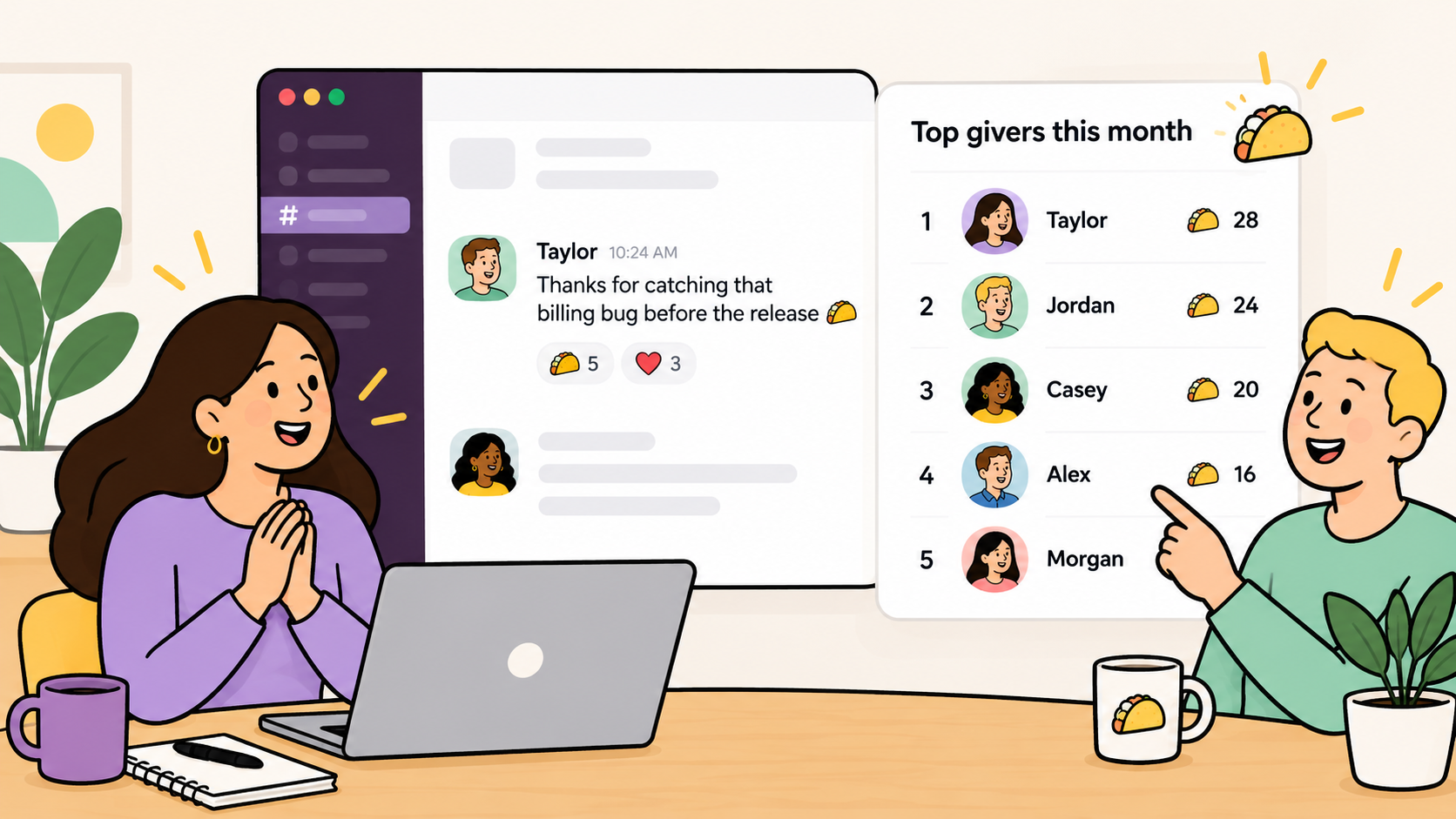

Performance reviews can feel planets away from employee recognition.
With recognition, we’re devising dozens of tiny ways to make someone feel appreciated, seen, and bonded to their team. Psychological safety, no invisible work. A culture teeming with rituals, just downstream from a wellspring of gratitude.
Then there are performance reviews. Employees can spend the days leading up to this bracing for impact. Managers can be equally nervous about having a tough conversation. It’s rare that both parties are exactly where they want to be.
Continuous recognition can change that, and not because it gives us a chance to shoehorn in more compliments. It satisfies something everyone wants at work: fairness.
Employee recognition and performance management: What’s fair?
A lack of continuous recognition hurts how productive and constructive performance reviews are. Especially when we’re using numerical ratings to assess performance. Studies confirm that employees perceive narrative feedback as fairer, and narrative is nothing if not contextual.
A few examples of how it can add context and improve the trustworthiness of every review:
- “You log off early pretty consistently.” Recognition data shows this employee being thanked for always volunteering for early client calls. Their hours have informally shifted.
- “You’ve been pushing back.” Recorded recognition shows this person regularly catches errors that could eventually hurt the company’s rep. They have high performance standards.
- “You take forever to respond.” This employee is forever getting tacos from their coworkers for buckling down and expanding their deep focus time to do the tasks others would rather avoid.
None of this suggests that a behavior shouldn’t be adjusted. Performance reviews aren’t a celebration, nor are they the time to heap recognition on someone. However, the employee will be more willing to make a change when you aren’t exhibiting a blind spot.
Discover what HeyTaco can do for your team
See how HeyTaco makes peer recognition simple, fun, and impactful.
Explore HeyTacoPrinciple 1: Giving praise while it can still create momentum.
Humans repeat what gets reinforced, and they don’t forget who encouraged them on the path to success. This one simple truth reveals the link between recognition and performance in every area of life. It’s only at work that we call it continuous recognition, and it emphasizes the importance of timeliness in praise.
Giving recognition continuously is the only way it can truly enhance a performance review. Therefore, we’re locking in reasons to acknowledge someone beyond an end result.
Quick wins:
- Tie recognition to core value-driven behaviors
- Recognize who someone is becoming, e.g., leadership qualities
- Be clear about affirming behaviors (“Keep that version, that’s our standard now.”)
Principle 2: Peer-to-peer recognition for accuracy and trust.
When praise feels real, you trust where it’s coming from. It’s easier to find this among coworkers. This method also ensures we get the frequency and specificity necessary to make it useful to review.
For the individual, hearing peer feedback during a performance review adds credibility. It neutralizes defensiveness and reminds them that whatever needs improvement, their place on the team is still notable.
Quick wins:
- Peer-to-peer recognition built into workflows to make it habitual
- Team rituals built around spotlighting specific strengths
- Celebrations where peers surface contributions that were missed during the week
Principle 3: Bringing receipts and eliminating bias during reviews.
There’s nothing like a terrible week this month to erase last quarter’s astonishing achievement. Such is the case during a performance review rife with recency bias.
Vague, incomplete, and biased reviews harm performance, engagement, and even retention. At the same time, we have to be cautious not to “soften” important feedback with assurances. A mix of qualitative and quantitative feedback from the entire review period is the best way.
Quick wins:
- Use platforms such as WorkStory to record regular feedback every two weeks
- Combine data and stories for a holistic performance picture
- Bring up specific moments over general takeaways
Principle 4: Praise as a mirror, review as a path forward.
Performance reviews should feel like a conversation. Discussing what recognition tells us isn’t fluffy stuff. It trains everyone’s eyes on where we can see performance continue or improve.
For instance, share three shout-outs someone received and ask which is most meaningful and why. This is insight into value alignment, goals, and more that can help turn a review into a map of their future.
Quick wins:
- Turn repeated praise into a role (“Where else can we best utilize your attention to detail? Could you coach 1:1 on presentations?”)
- Stretch a value (“You nailed autonomy. Here’s how you can master accountability by next quarter and become rather unstoppable.”)
- Look deeper at a unique shout-out (“This was the first time you were praised for being so dependable. What made the difference?”)
What if there’s a recognition gap?
The role of employee recognition in performance management appears to cave in when someone doesn’t have a lot of recognition activity. On many teams, there will always be select individuals who look low-impact on that front. Here’s what to do, even if it’s on short notice.
Know the types of invisible work, and find theirs.
Glue work is ticketless, but holds teams together. This person knows where to find everything and seems to exist to remove friction. They know what burnout looks like and support those showing the signs. If they’re not being recognized for this, it’s because everyone is too used to it.
Preventative work is going out of your way to fix things before they break. Unblocking, debugging, and keeping up with organizing files live here. This is often someone with more tenure or experience who doesn’t bother trying to train everyone else.
Behind-the-scenes growth work usually means handling logistics, taking notes, reports, and more. They’ve grown a little bit beyond their roles because they see the need. They’re often siloed with no one to witness the 10 extra little tasks they deem necessary to “do it right.”
How to close the gap before review.
Noting feedback every few weeks can prevent this in the future. So will identifying someone’s invisible contributions and making a wider audience aware. But if you know someone is good but have no receipts, start by checking recognition rank.
Basic insights such as who gets the most recognition, and for what, can indicate why some people aren’t getting as much. It’s probable that they’re just not speaking up to announce they’ve handled it.
Next, ask someone, anyone else. Ask a peer of theirs if they’ve done something to make work easier in the last month or two. Ask a supervisor if they’ve noticed anything, from communication habits to meetings, that’s worth praising.
Finally, find a value. Some people are so aligned with values that they disappear into them. For example, someone who truly embodies ownership isn’t going to wait for instructions or praise.
Continuous recognition is for everyone. Performance is personal.
Performance reviews are arguably more psychologically involved and evocative than recognition. Recognition, especially peer-to-peer recognition, confirms we’re part of a community. That community isn’t present during individual review. In great company cultures, it may be the only time someone feels singled out.
But when a performance review matches the employee’s experience, it has a real purpose. Constructive feedback lands, observations feel true. It all starts with daily recognition. It’s one of at least two forms of consistent, recorded feedback that make performance reviews worth the worry.