
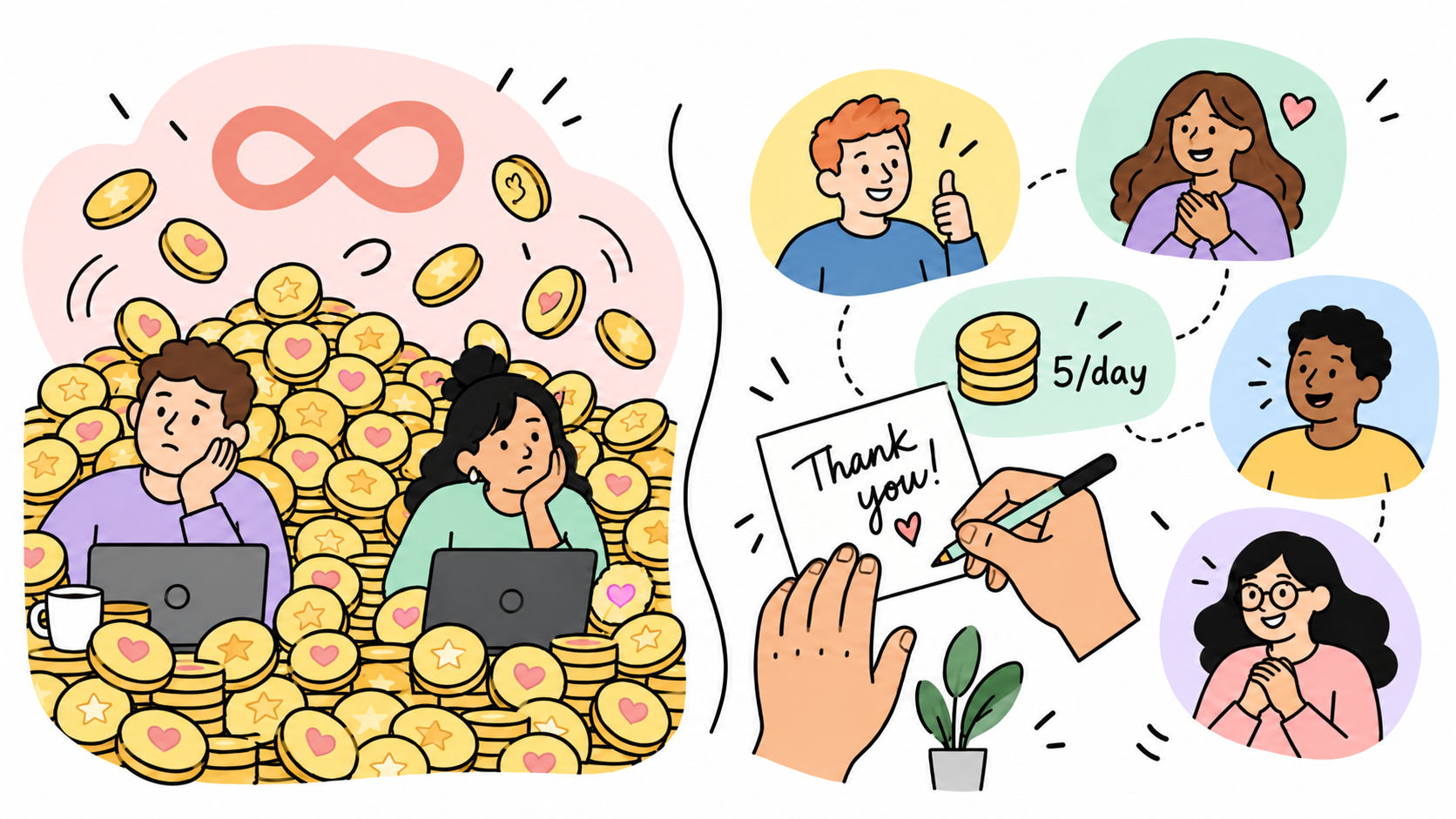
Every recognition platform wants to sound generous. "Unlimited points" is an easy pitch—more is better, right? But if you've ever watched a recognition program get a big launch, a burst of activity, and then quietly die three months later, unlimited points are usually part of the story.
TL;DR
- Unlimited points remove the one thing that makes recognition a habit: friction that forces a daily decision.
- A hard daily limit doesn't restrict generosity — it protects it from favoritism and burnout.
- Teams using a daily-limit model give peer-to-peer recognition far more consistently over time than teams on unlimited-point systems.
1. The unlimited points problem.
The fix: stop treating "unlimited" as a feature. It sounds like abundance. In practice, it's the absence of a decision. Without a daily limit, there's no daily reason to open the app today instead of tomorrow. Recognition becomes something people do when they remember to, not something built into the week's rhythm.
This is why so many recognition rollouts follow the same arc: a big launch, a spike of activity as everyone tries the new toy, and then a slow fade as the novelty wears off. Nothing about the tool changed. What changed is that there was never a reason to come back today specifically.
The favoritism problem nobody mentions.
Unlimited points have a second, quieter issue: they let recognition pool around the same few people. The loudest team member, the one whose work is easiest to see, the manager's favorite project — they rack up points because giving costs nothing. Meanwhile, the person quietly keeping a system running gets recognized once a quarter, if that — the same visibility bias that shows up against introverts in any recognition system that doesn't force a real choice.
Ready to make appreciation an everyday habit?
Try HeyTaco free for 30 days. No credit card required.
Try HeyTaco free2. What a daily limit actually does.
The fix: give people just enough that they have to choose. A limit isn't a restriction on generosity — it's a forcing function for intention. When you only have a handful of tacos to give today, you think about who actually earned one. That small moment of thought is the whole mechanism. It's the difference between recognition as a reflex and recognition as an afterthought.
It also resets the clock. A points balance that never empties accumulates — there's no urgency to use it. A daily allotment that disappears at midnight creates a small, low-stakes "use it or lose it" nudge. That nudge is what turns a nice-to-have into a habit.
The consistency gap is real.
This isn't just a theory — it shows up in the data. Teams on a daily-limit model give recognition roughly 4x more consistently over time than teams on unlimited-point systems. Unlimited platforms tend to spike hard at launch and taper fast. Daily-limit platforms start smaller and stay steady, week after week, month after month — which is the actual goal. A recognition tool that gets used once is a gimmick. One that gets used every week is a culture.
3. "But doesn't a limit feel stingy?"
The fix: make the limit generous enough to use, tight enough to matter. This is the real objection, and it's worth taking seriously. Nobody wants their team to feel like appreciation is being rationed.
The answer isn't zero limit or no limit — it's finding the number that's enough to recognize the real moments in a normal day without being so high it stops requiring thought. Five is enough to thank the teammate who covered your meeting, the person who caught a bug before it shipped, and the coworker who just made a rough week easier — with a couple left over for something that comes up later. It's not enough to hand out on autopilot. That's the point.
4. What this looks like day to day.
The fix: let the limit do the work quietly, in the background. Nobody should have to think hard about the mechanic itself — it should just shape behavior naturally. In practice, that looks like:
- A team member gets a taco for staying late to fix something that would've been someone else's problem in the morning.
- A manager notices they've only given two tacos by Thursday and makes a point to look for who they've been missing — the same instinct behind rituals like celebrating your top taco givers, not just receivers.
- Someone quiet who rarely speaks up in meetings gets recognized for work that would otherwise have gone unseen, because a teammate had to actively choose to spend a taco on them instead of defaulting to the loudest person in the room.
None of that requires training or a program rollout. It's just what happens when the mechanic nudges people toward intention instead of volume, tied to core values that actually mean something rather than sitting in a handbook nobody opens.
The takeaway.
Recognition tools don't fail because people stop caring about their teammates. They fail because the tool removes the small daily reason to act. Unlimited points feel generous on a sales page and feel like nothing at all six weeks into actual use. A limit — the right size, reset daily — is what keeps recognition from becoming just another notification people learn to ignore.
Ready to make appreciation an everyday habit?
Try HeyTaco free for 30 days—no credit card required.
FAQ: Recognition points and limits
Why do unlimited recognition points lead to less consistent use?
Unlimited points remove the daily decision that makes recognition a habit. Without a limit or a reset, there's no specific reason to give recognition today instead of next week, so usage tends to spike at launch and fade from there.
Does a daily limit make recognition feel restrictive?
Not when it's sized right. A daily limit should comfortably cover the real recognition moments in a normal day, with a little room to spare — tight enough to require a small amount of thought, generous enough that it never feels like rationing.
Does limiting points reduce favoritism?
Yes. When giving is free and unlimited, recognition tends to pool around the most visible people. A daily cap forces a choice each time, which naturally spreads recognition out instead of letting it concentrate on the same few teammates.
What's a good number for a daily recognition limit?
It depends on team size and culture, but the number should be small enough to matter and large enough to cover a normal day's worth of genuine moments — enough to recognize two or three real things without leftover points piling up unused.