
I recently spoke with a customer who was preparing to launch HeyTaco. They were worried because they had no real plan for how to introduce it to their team, what rewards to offer at launch, or how to use the leaderboards. They were planning to go back to the drawing board for a month or so to get a full plan in place before they even gave their first taco away.
And that is not that uncommon. Oftentimes, our customers fall into two camps. In camp A, they create beautiful plans ahead of launch that include anything from objectives to KPIs, the types of rewards they want to use, to company-wide celebrations that the HeyTaco leaderboard will inspire. Those plans are beautiful, clearly thought out and defined, and the team that put them together clearly knows what they were doing.
The other people in camp B often don’t know where to start, and as a result, never get started. They want to create a complete plan like the folks in camp A above, but never get around to it because, understandably, there are so many other initiatives and things to take care of.
At HeyTaco, I have seen many launch and use HeyTaco to the point where tacos become synonymous with thank you. Tacos and thank-yous become part of their DNA to the point where new employees think HeyTaco is a solution the team developed in-house. I love hearing that! We love being part of a team to the point where the lines between them and us blur; it’s all about sharing gratitude together. When I look at what those teams that have built a true culture of gratitude powered by tacos have in common, one thing stands out: they launch and manage HeyTaco as an evolving thing, often unknowingly guided by Design Thinking principles.
Those principles, applied from the start, bridge the gap between having all your ducks in a row before even starting the HeyTaco free trial and not having any plan at all. A golden middle exists when you spend a little time designing and thinking through what you are trying to accomplish.
What is Design Thinking?
Design Thinking is a problem-solving approach that focuses on understanding people's experiences and needs to come up with innovative solutions. Companies use Design Thinking to ensure they are solving real problems for real people and that the solutions they create address those problems. This approach encourages empathy, creativity, and having an iterative mindset.
Since Design Thinking emphasizes focusing on humans, what better place to use it than in HR?! As a member of an HR team, everything you do focuses on the humans in your organization and improving their experiences. As much as you may want to improve processes, we know it doesn’t always work when you bring humans into the picture. They may not follow the new process as expected; they may be frustrated by the change, or it may not be a process they need at all! It’s a terrible feeling to spend months developing a plan and a solution that doesn’t end up being used.
Design Thinking tools can help you better understand your employees' needs and desires, so you can design programs and solutions that create the most value and have the biggest impact. Design Thinking helps HR professionals step into employees' shoes and understand what truly matters to them. This understanding is critical when launching or revamping employee recognition programs. Instead of spending a lot of time designing and implementing generic programs without knowing if they'll actually resonate with employees, you can use Design Thinking to empathize with employees, understand their motivations and challenges, and iteratively create the best solutions for them.
How can Design Thinking help you create a successful recognition program with HeyTaco?
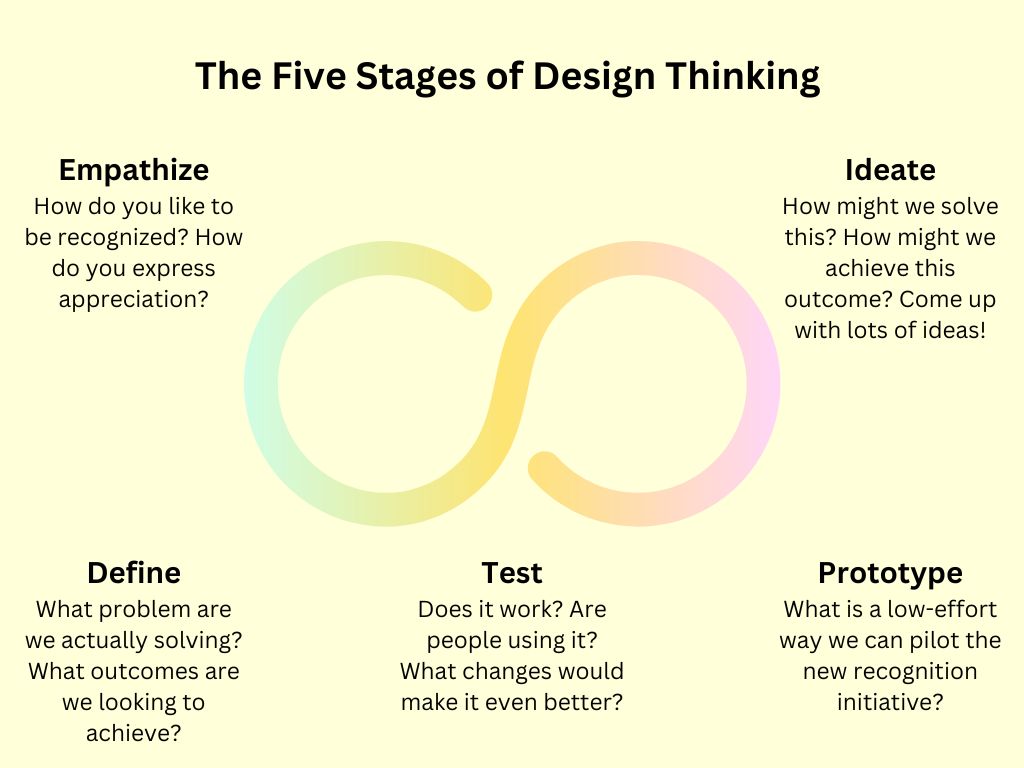
The Design Thinking process involves 5 key steps: empathize, define, ideate, prototype, and test.
Empathize: Learn about the people affected by the current problem by conducting surveys, focus groups, and interviews to understand what matters to them and what their current pain points are. An empathy map is a great tool at this stage to brainstorm with your team and visually display what you’ve learned about your main customers (in this case, your company's employees). You can even consider doing empathy maps for different types of employees, as it makes sense for your company! For example, newer employees and tenured employees.
When creating a recognition program with HeyTaco
Ask your employees direct questions, but also observe their behavior and interactions. Some questions to ask them directly include ‘How do you like to be appreciated? How do you like to express appreciation?’ The five languages of appreciation in the workplace are a great framework to understand where your employees fall on the scale. As you observe behavior and interactions, notice whether leaders share recognition in a public forum and whether there is chatter in company collaboration channels that isn't tied to work. Observe whether there is a feeling of connectedness and camaraderie on your team and whether everyone understands how their work and role fit into the bigger picture.
Define: Based on the information you gathered in the previous step, you can now better define the problem you’re solving and the outcomes you want your solution to achieve. These are concrete statements that you can use for more productive ideation.
When creating a recognition program with HeyTaco
You might learn that people feel recognized by their managers, but would like to be seen more by their colleagues in their daily flow. The outcome you might be looking for is that taco messages of appreciation are sent in your public channels every day (as opposed to at the end of the week or month).
Ideate: Now it’s time to get creative! In this stage, you brainstorm different solutions to achieve the outcomes you want.
When creating a recognition program with HeyTaco
HeyTaco isn't one-size-fits-all, so coming up with ideas that work for your team is key. Some ideas for the problem you defined above could be encouraging leaders to send daily taco messages, YOU as the leader of the initiative committing to sending a few tacos a day to people you appreciate, and adding ‘taco shoutouts’ as an agenda item to your All Company meetings where you get to publicly recognize the awesome taco messages being shared amongst your employees.
Prototype: After brainstorming, pick a couple of the top solutions and create very low-effort ways to try them out. These could be pilot programs or website mock-ups, but they should be small-scale to allow for refinement and testing.
When creating a recognition program with HeyTaco
The ideas above might be great in theory, but your team might not like them. At this stage, try doing ‘taco shoutouts’ in your company meetings for a few weeks and see how people react.
Test: Gather feedback on the prototypes and adjust based on what you learn. This is where it’s important to be iterative! Since you started small, it’s easier to make changes and tweaks so the end result is something people actually need and will use. Or if it’s not working out, then you’ve ‘failed quickly’ and haven’t wasted a lot of time and effort, and you can go back to the ideate phase to work on a new solution!
When creating a recognition program with HeyTaco
You might find that people don’t like ‘taco shoutouts’ at public meetings, but they really like the summary of all the awesome things people are appreciating. That might lead you to share a written summary in a weekly email or Slack/Microsoft Teams, or you might learn that ‘taco shoutouts’ are more fun in public meetings when you do them quarterly. You can only see so much from a single vantage point, so testing and learning is key to finding a mix of HeyTaco practices that resonate with your team.
To sum it up, on the spectrum from thoughtful to rash, there is a middle ground: thinking and designing your way through a solution. It’s a perfect combination of being thoughtful and acting to find a way that takes care of what matters to you.
This blog post was written with Caitlin Anderson from Thinkly Solutions.