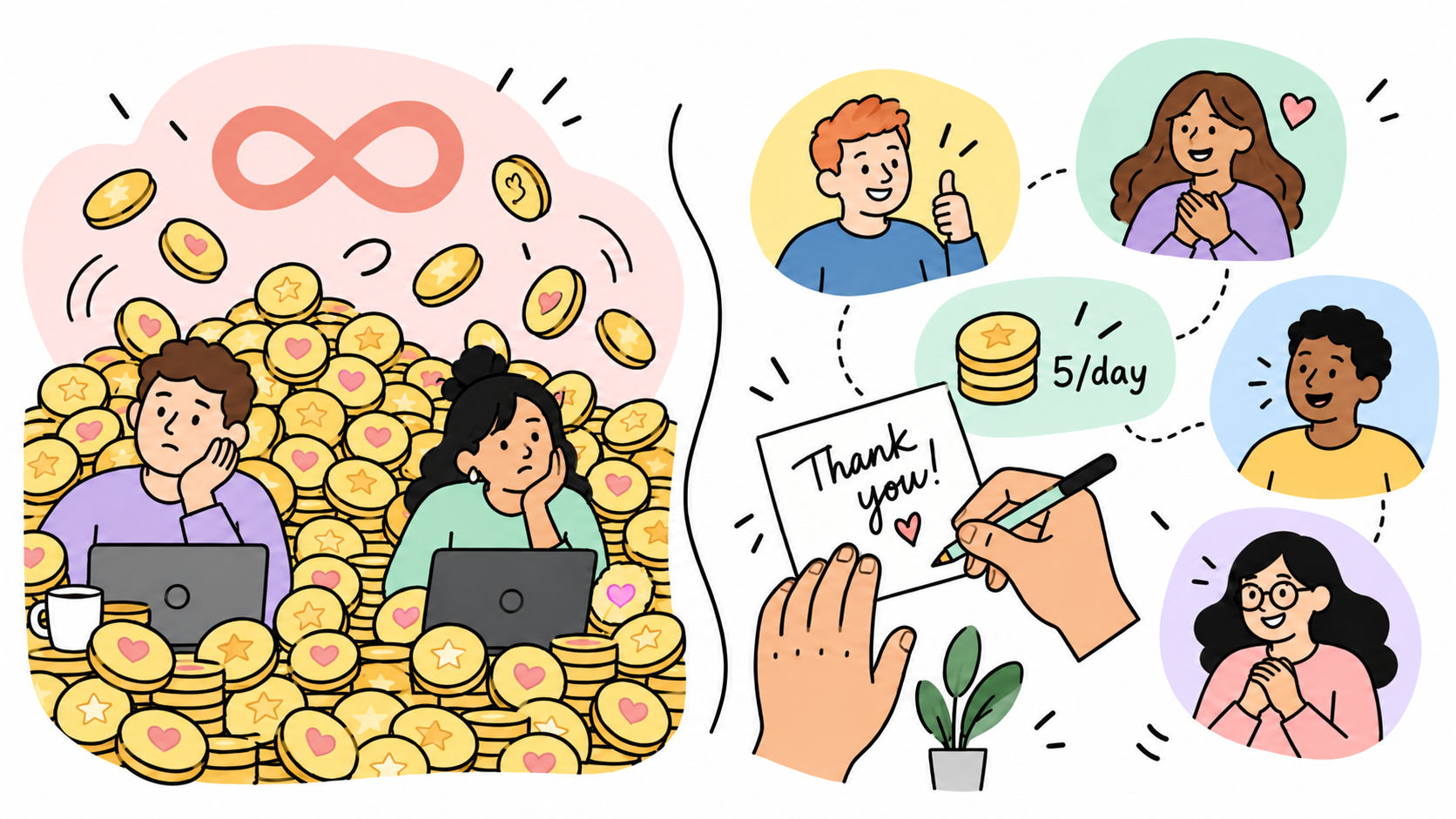

TL;DR: Peer recognition is when employees acknowledge colleagues’ contributions, behaviors, and wins without waiting for a manager. Done consistently, it builds belonging, engagement, and retention.
Emma has been working as a data entry clerk for a few months. Her manager and a senior team member compliment her work's quality and speed at least once a week, so she knows she’s doing well.
A lot of her coworkers have been there longer than she has. They seem to have already formed pairs or small cliques. They’re helpful when she has a question, but she thought she’d feel more comfortable asking by now. Or that they might reach out to her for something.
She doesn’t want to try too hard or interrupt, and no one’s rude to her. Still, Emma’s starting to feel like she barely exists unless someone addresses her directly. Most coordination and collaboration happen over email, even when she’s sitting mere yards away. She’s practically on autopilot five months in.
Emma isn't exactly sure why, but she decides to keep an eye out for openings elsewhere, just in case.
A good company, work she can handle, and recognition from management. Yet Emma’s morale and motivation suffered. The environment isn’t very inclusive, which makes her second-guess herself daily.
Emma’s overall job satisfaction started to tank because she lacks peer recognition, so she doesn’t feel seen or valued by her coworkers.
What is peer recognition?
Peer recognition is when employees acknowledge their colleagues’ positive behaviors, performance, and other contributions at work.
When it’s given consistently, peer recognition helps employees feel like they belong to a team. That increases workplace happiness, retention, motivation, and collaboration.
Top-down employee recognition effectively motivates employees and confirms that their work is valued. Peer-to-peer recognition creates an ongoing positive feedback loop that motivates employees in real time as they complete their work.
Why is peer-to-peer recognition so important?
You can promise rewards, raises, and PTO all day, but peer-to-peer recognition is what drives job satisfaction and retention. It’s a broad collection of small (sometimes almost imperceptible) gestures that keep employee motivation and morale up.
You can’t help but think, “It’s not the destination, it’s the journey.” As you know, this is about how the experiences we have along the way can end up being as valuable as, or even more valuable than, the goals we meet.
Suppose you train for a marathon and hate every minute. It’s always raining and you get injured. The big day arrives, and you complete the marathon, thinking, “Finally! Can’t wait to never do that again!”
It’s like that at work, too. Top-down recognition (from management) feels like an achievement. “Yes, I DID do a great job on that report!” But what about trying to collaborate with your coworkers? If communication was poor, things got tense, and the workload became unbalanced; you learned you can’t rely on your coworkers to succeed. You have to do it despite them.
Managers can’t validate every positive action an employee takes. Even if they tried, they probably still don’t have a 360° view of what the job entails. Coworkers can relate on deeper levels. When they recognize their peers, the recipient knows it’s for real.
Consider the story we opened with. Emma knew how to do her job, and management recognized her efforts. But she never felt like she fit in, so exceptional performance stopped mattering. Who wants to put forth their best in a place where they don’t belong?
Peer-to-peer recognition works so well because it ignites intrinsic motivation. The simple enjoyment employees get from working with their team is just as crucial (if not more) than extrinsic motivators like special appreciation or a reward.
Peer recognition examples
Let’s take the pulse for a moment. All of the following acts are peer recognition examples. Encouraging or building a program that enables more of this helps create a culture where it naturally happens more often.
Shouting out coworkers on social media
Employees don’t have to be off-the-clock besties, but it’s a good sign if they’re not shy about posting about one another. Endorsing a coworker on LinkedIn or wishing them a happy birthday on Instagram are great ways to recognize peers.
Positive team chat activity
Being responsive in chat is another example of peer recognition. Team members may quickly answer questions, thank one another for help, or comment on the day’s events.
Coffee breaks and lunches
You may not think twice about coworkers getting lunch together or bringing someone a coffee, but this is authentic peer recognition. It shows a level of rapport where conversation, companionship, favors, and other acts are the norm.
Easy encouragement
Do employees at your organization demonstrate faith in one another’s abilities? A simple “You’ve got this” or “Try it this way” shows that peer recognition is alive and can thrive in your workplace.
Happy to fill in
How do others react if someone is out sick, has to leave for an appointment, or otherwise can’t complete their role for a day? It depends on the industry and workload, but a willingness to take over is great peer recognition.
It shows they care about both the company’s goals and not letting teammates fall behind.
What peer-to-peer recognition ISN’T
Before we move forward to how you can revive peer recognition in a dead zone, let’s clarify what we shouldn’t bother doing.
Forcing coworkers to be friends
The main goals are positive interaction, respect, and cooperation at work.
Forging friendships with coworkers is great, but many people prefer maintaining professional boundaries. Successful peer-to-peer recognition isn’t reserved for those who feel comfortable being close buddies with colleagues.
A means to an end (rewards)
We don’t emphasize monetary rewards because that hinders authentic recognition. Employees should understand the recognition program and what it entails, but rewards shouldn’t be the primary objective.
An answer to poor performance
Of course, morale and engagement aren’t always why employees struggle with the requirements of their job role. Increased peer-to-peer recognition can boost performance, but it may also reveal who lacks the skill or will.
Quick peer-to-peer recognition ideas you can implement this week
Put the right tools in the team’s hands, and they can start building today. Here are some fast, practical peer recognition ideas.
1. Use peer-to-peer recognition software
This is our first and most important idea for a few reasons.
First, most recognition software adds gamification. Gamification can enhance everything from training to team building.
Next, we have analytics. The right software will help you measure the success of your peer-to-peer recognition program.
Finally, we are a peer-to-peer recognition platform. We’ve seen the results firsthand, whether strengthening remote teams at tech startups or tripling recognition among resident physicians.
2. Peer award nominations
Telling a bunch of adults to say please and thank you more often can be a bit awkward. The same can apply when you want them to start being more considerate and thoughtful toward one another organically. Break the ice by asking for their opinions on who is doing a great job.
If you have a reward or award program in place, such as Employee of the Month, get the team involved. Have everyone nominate an employee for a reward with specific reasons why they should win.
The winner (or winners) will feel seen and appreciated by their coworkers, and coworkers will become more comfortable sharing positive feedback about their peers.
3. Employee recognition walls
Supplement the two peer-to-peer recognition ideas above with a wall. Employee recognition walls are physical or virtual spaces where gratitude and success take the main stage.
Highlight good deeds, share fun employee facts, create a company vision board, or post the best company reviews. For more inspiration, check out our post on creative employee wall ideas.
An employee wall simply offers another venue for peer recognition. You can customize its appearance and contents to match company values and employee preferences.
HeyTaco: Your ready-made peer recognition program
Peer recognition ties teams and companies together in a lasting, meaningful way. It takes the pressure off busy leadership and helps siloed or still-acclimating employees feel like they belong.
If you’re starting from a low point, it sounds like a mountain to climb. But HeyTaco offers a casual, fun, and insightful way to begin.
- HeyTaco integrates seamlessly into Slack and Microsoft Teams.
- Employees can recognize someone’s positive actions by dropping a 🌮. It’s like saying thank you, but for way more scenarios. See someone giving another employee a tip? 🌮. Did someone make you laugh? 🌮. Want to congratulate someone on completing a task that gave them trouble? 🌮. It can also be more memorable because we get so used to "thank yous." You can even add Taco Tags to align tacos with company values, like creativity or social consciousness.
- HeyTaco’s leaderboards add gamification and friendly competition. Here, you can see who gives the most recognition and who receives the most. “Players” ascend levels, unlock avatars, and earn rewards, all without interrupting their workflow.
- An analytics dashboard helps you measure engagement, track trends, and otherwise make better-informed decisions around recognition programs.
- It’s free to try.
Peer recognition definitions and benefits may vary, but one thing stays the same: the power of positivity. It doesn’t have to be complex or cloying; we just need to create opportunities for it.
Whether or not you take HeyTaco for a spin, put recognition in employees’ hands and create more chances to highlight the positive.