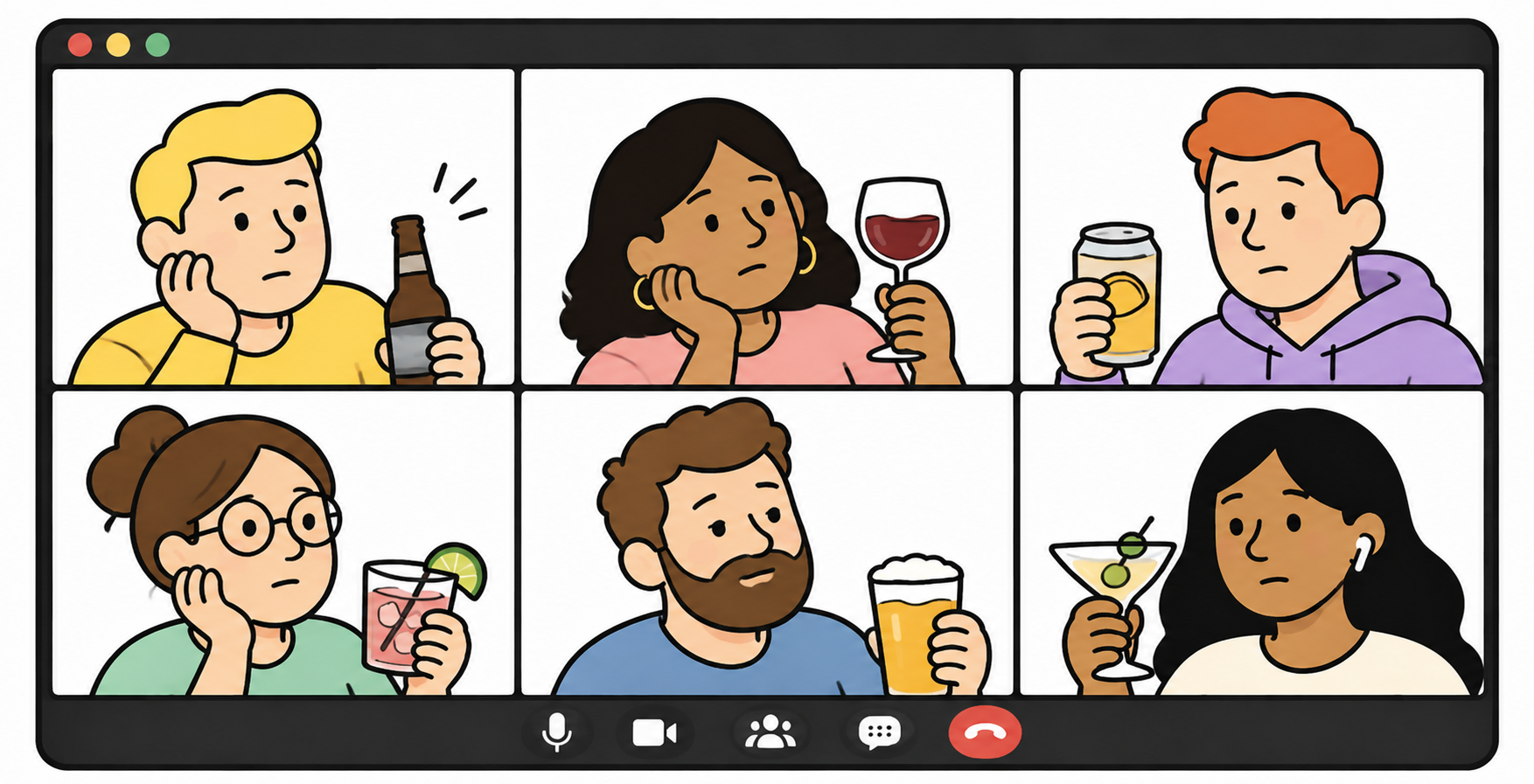
You assumed that the first virtual happy hour you ever attended would be your last. We were all surely headed back to the office next week. Or month, or year.
There was an expiration date on those events, but not because we all got our RTO orders. Everyone got over them. We enjoyed the novel experience of grinning into our cameras and watching a coworker get tipsy. Then we remembered martinis taste better on the couch, where no one can see the stains on our favorite T-shirt.
"Those virtual scavenger hunts and games and all that stuff, [they’re] good one-offs,” agrees Camilla Booth, VP of People at Coder. “But for something to stay years and years and years and to scale, I think it needs to have simplicity and fun."
Keep reading for more experience and advice directly from people who would know. Here’s what teams who use HeyTaco have to say about evolving a remote-first culture when it no longer feels shiny and new.
Evolving remote work culture never happens by accident.
You’ve seen enough of Sally’s sweaters to know she’s a little silly. So when you lean over the office chrysanthemum and trill, “Mum’s the word!” your suspicions that it’ll get a giggle out of her are proven correct.
What used to be free and easy (office culture) is now done by design. Brad Williams of WebDevStudios got hip to this years ago. He realized that culture as we knew it was just a side effect of absorbing one another’s physical presence.
Chris Hull of Otus is another founder who discovered that a remote-first culture was an architectural feat instead of an unspoken patchwork of interactions.
This isn’t “extra work” as much as it is a reframing of where culture comes from and how it takes shape. Hull assures that over time, “you can make any group coalesce.” Williams’ team enjoys 25% participation on some intentionally scheduled game nights. They even share what their sweaters look like on Zoom, on purpose.
| 🔑 Work culture has evolved from sight to insight. Instead of making everyone look at each other, we drill down into which interactions they’d most benefit from, and when. |
Why did the standard remote-first culture events start backfiring?
If quirky sweaters and game nights are still going to end up on the menu, what exactly is the big deal?
The next time you snapshot a shopping receipt for the Fetch app, think of Justin Tsatsa. He’s their Associate Director of Workplace Operations. As a culture-builder, he experienced many disappointing remote events, from empty co-working rooms to awkward coffee chats.
The difference is that he picked up on why no one wanted to do this stuff: he was over-programming, and his people were over-scheduled as a result. This is what has propelled “Zoom fatigue” from colloquialism to a scientifically validated workplace condition. Tsatsa already knew that his remote-first culture needed structure, but he couldn’t speed-run it. Quality had to come first.
ERG events became bigger moments that happened less frequently. Games were integrated into town halls. The extra fun stuff he planned came with less pressure and more meaningful interactions from people who wanted to be there.
| 🔑 When a team is already juggling ERG events, town halls, and team meetings, they’re less likely to be interested in an after-hours magic show. |
5 Ways to evolve into remote culture 2.0
Do something, but not too much. Plan it, but don’t overthink it. Come up with fresh ideas, but don’t overprogram. It’s no wonder companies give up.
Fortunately, plenty of teams have shared what specific habits, principles, and activities have taken their culture into a new age.
Focus on low-effort, async habits.
The first intervention is introducing remote team rituals suited to asynchronous work culture. That means no stiff time constraints or calendar intrusion.
Recognition channels are the introductory pick among HeyTaco users. Others include group activities people can submit to on their time, like Fetch’s team recipe book. Other async rituals to try:
- Make a playlist every sprint where people can share their favorite songs.
- Create an “unsung hero” thread every week so busy people can play catch-up on recognizing others.
- Create async-friendly video and audio clips sharing knowledge instead of pulling people into meetings.
Engineer the “random” collisions.
Steve Hedrick of AVN Corporation sends his whole team emails about new hires. But instead of just regurgitating their resume and warning everyone to welcome them, he shares their interests.
It isn’t certain that anyone will remember the action of reading this specific email. But the next time they see Wesley get pinged in Slack, they think, “Oh yeah, the banjo player. Cool guy!”
That’s just one example of arranging a connection that later feels as though it came on its own. Another is what HeyTaco does with Quests. It improves the idea of a virtual water cooler by having voluntary meetups start with text instead of a calendar-bound video meeting.
Most critically, it isn’t random. You can use data to pair people up without making them feel like they’ve been to see a matchmaker.
Make in-person time count.
Off-sites and real-time activities need a cadence to be ritualized. Sometimes, you can just offer a perk, like paid lunch. Katie Regan of Kirkpatrick Group does this with her remote team. The lunch call has no agenda, and everyone just hangs out.
That said, Kirkpatrick still does a five-day retreat without any work. Katie Carrigan of Goody arranges this for her team once a year, too. Bureau of Digital finds that they need at least twice a year.
As owner Carl Smith explains, “When you've hung out that one time, it's not like you're 800 miles away and I close my laptop and I don't care… I found out that we both love Iron Maiden, right? And now I'm not just closing my laptop.”
Let the crew own it.
When remote team rituals don’t work, it’s usually because people feel it was imposed on them. Employees are the ones who have to propel culture forward even if the idea wasn’t theirs originally. It’s what makes a company feel like “us” instead of a standard initiative handed down from leadership.
The honesty and democracy of peer recognition is the first intervention here. You don’t need a manager present to have your work validated. Appreciation is a positive exchange that lives in the flow of work instead of being saved up for special occasions.
When organizations do design successful culture, they personalize it. Pirate Ship, a shipping software company, has an artist-in-residence who draws character pics of employees for their Slack avatars. Even then, people have a choice and are able to pick their own character.
Discover what HeyTaco can do for your team
See how HeyTaco makes peer recognition simple, fun, and impactful.
Explore HeyTacoBe honest about limits.
So much of what we experiment with is an attempt to emulate someone who did it better. In truth, they didn’t do it better; they did it best for their team. Evolving remote work culture can mean bucking trends or even implementing something some would consider controversial.
For instance, Sondre Rasch of SafetyWing keeps his team separated. “You have remote teams, and you have non-remote teams because they should be managed differently,” he observes. This can facilitate building the best possible culture for each model instead of messing around with merging.
Meanwhile, Francesco Vetica of Fifth Beat leads a team that goes above and beyond in inclusion. "We just speak in English straight away, even if there would be just one [English-speaking] guy and 10 were Italian."
Pushing cultural procedures, values, and activities that aren’t sticking doesn’t make us tenacious. It’s beating a dead horse. Remote, async, and hybrid teams all come with pitfalls. Admit yours!
Remote-first culture that isn’t a drag: Your 30-day plan
Want to evolve your remote culture in one month? Adapt this 30-day plan to your needs and water what grows.
Week 1: Make more status updates async and start trimming away at live meetings. Try a weekly Loom thread where the team can share where they’re stuck or what they did. Everyone has a day to contribute instead of a few minutes.
Week 2: Add chat-native peer recognition to Slack. Start a channel for specific gratitude. (Pirate Ship calls theirs Kudos Cove.) Begin ritualizing celebrations with a weekly wins retrospective.
Week 3: Start pairing people up on purpose. Give them a few days to collaborate on a document, solving a problem together, or set them up on Quests. Implement any idea that reduces pressure and keeps the calendar de-bloated.
Week 4: Maintain the calendar at 50% less live. Now you’re all clear to add one bigger, really meaningful live event. Give it structure and purpose while inviting everyone’s input. Think more like “Plotting our team’s Q4 roadmap,” instead of a no-topic hangout.
Need more? Find out why recognition is the biggest culture-builder on remote teams.
See HeyTaco in action
Watch a quick demo and see how peer recognition works in Slack and Microsoft Teams.
Watch the demo