
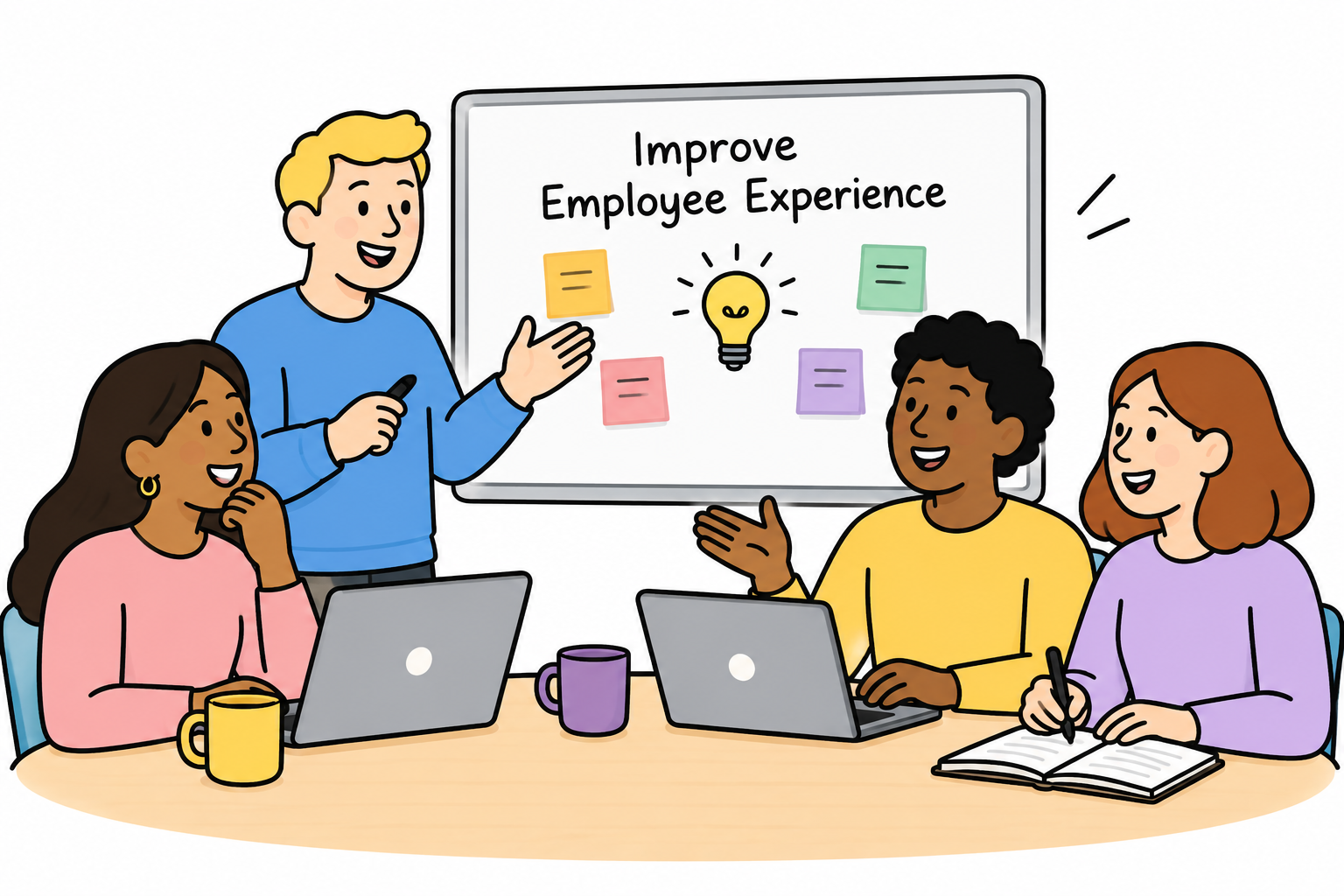
You’ve been checking the oven every two minutes to see if dinner’s ready, but you forgot to turn the oven on. This is a lot like attempting to improve engagement with surveys instead of looking at employee experience.
TL;DR
- Employee experience (EX) describes the broader work environment.
- The three employee experience pillars are cultural, physical, and technological.
- A positive employee experience can result in higher engagement and retention.
What is employee experience? The simple definition
Employee experience, or EX, is everything a person sees, feels, and hears on the job. It’s every environmental factor, the sum of all interactions at work that shape overall perception.
Examples of employee experience
| Work area | Positive experience | Negative experience |
| Onboarding | A clear 30/60/90 day plan with milestones, a warm welcome from new coworkers and managers alike. | The first day is spent alone, waiting for site credentials or access permissions. |
| Communication | Regular town halls and Q&A sessions, firm guidance for how and when to reach out to anyone. | The team learns about major executive shakeups, mergers, or other changes on LinkedIn. |
| Flexibility | Solid core focus hours bookended by flexible start and end times. | No real async consideration for distributed teams, everyone is essentially expected to be available 24/7. |
| Recognition | Peer-driven kudos system that highlights small, daily wins. Tangible and experiential awards tailored to the team. | Top-down and performance-based. The same people get praised by leaders again and again. |
| Wellbeing | Considerations such as mental health days are kept separate from sick leave. The company has a clear stance on respecting its people’s personal time. | PTO use is brought up negatively during performance reviews. Visibility and presenteeism are more important than the quality of one’s output. |
| Meetings | One guaranteed meeting-free day a week. All meetings have a defined agenda invitees receive before the meeting. | “Quick huddles” go off track for an hour; employees may spend more than half of the average workday in meetings. |
You’ll find your organization is somewhere in between on some (or a lot) of these. That’s normal. Designing the best employee experience for your team is better than forcing positivity.
For instance, some teams don’t include rewards in their recognition program, and they have very enviable cultures. Sometimes, a meeting-packed week is how we get larger projects off the ground.
Employee experience vs. employee engagement
When orgs measure and monitor employee engagement, they don’t differentiate it from experience. That’s how these terms get used interchangeably.
Experience is the reason; engagement is the response.
The obsession with manipulating and increasing engagement rates is a little misleading, because you can’t directly edit engagement. Saying, “We’re doing this to improve engagement,” really means you’re editing part of the employee experience.
You can increase recognition, improve communication, and design better work-life balance. This refines the employee experience, which in turn supports employee engagement.
Learn to find where you’re mixing them up.
Why does the distinction between employee experience vs. employee engagement matter that much? Because EX is a longer journey. Some common situations:
- Companies boost engagement by hosting events and giving rewards. That recognition helps engagement, but it has a ceiling. If outdated tools are making it hard for everyone to meet productivity standards, EX is going to suffer.
- Pulse surveys capture employee sentiment. For that day, anyway. The employee experience has to be tracked long-term: onboarding, role transitions, the whole nine. Addressing a survey response will not always reveal or remedy the parts of EX we need to fine-tune.
- Engagement is influenced more by relationships. A team can have consistently robust engagement rates thanks to a great manager and daily peer recognition. But systemic issues, like rigid policies and noncompetitive compensation, can hold the experience back. Again, we’ll see a limit to how high engagement remains.
Discover what HeyTaco can do for your team
See how HeyTaco makes peer recognition simple, fun, and impactful.
Explore HeyTacoThe 3 employee experience pillars
The employee experience pillars cover the three main areas that shape how workers view a job. Any solution you’re looking for in terms of engagement, retention, or organizational reputation is tucked somewhere in here.
I. The cultural environment
The heart of belonging
Cultures that have visible, believable core values, regular recognition, and connection create psychological safety. This is the pillar that is most intertwined with engagement.
When it’s broken: A fully remote worker has all of their tools and logins ready for their first day. The team chat is moderately active with work-related stuff, but the new hire doesn’t speak to anyone, and vice versa. They quietly complete their first day.
When it works: The same employee logs on for their first day. Their manager pings them in the public channel to introduce them. Everyone shares in welcoming them before core hours commence, including the teammate they’ve been paired with to get acclimated.
II. The physical conditions
Where work happens
Flexibility, safety, quiet. In-office or fully remote, this pillar concentrates on the employee’s daily reality. The work model dictates how much control a company has in shaping the experience.
When it’s broken: In-office: Firm hours five days a week, no parking. Remote: Constant availability in a cramped corner of the home.
When it works: Both can offer more flexibility in arrival/departure with core hours in between. This makes the work put forth more important than being visible. Remote may get a stipend for noise-cancelling headphones and an ergonomic chair.
III. The digital and technological environment
Tools and resources that help or hurt
Today, the tech stack threatens to introduce more friction than bad parking. Service management systems, HR systems, communication, and knowledge/resource access impact time, effort, and quality of output.
When it’s broken: Slack is active, but there’s a separate login for recognition. You have to fill out a form to send the kudos. Therefore, the tool is only used to cash in rewards when it’s time for points to expire.
When it works: Integrations are a key factor in tool adoption. In the case of frictionless recognition, the tool lives neatly inside the workflow and doesn’t require lengthy instruction or prodding.
How to improve employee experience without overpromising
It’s increasingly normal to find companies with an HR department of one, or a different department altogether handling EX. So naturally, you can’t “fix” all pillars at once.
Even on larger teams, multiple big fixes can feel destabilizing. Teams think, “Yes, it’s a mess, but it’s our mess!” That, along with the fact that you have to stick with the changes long-term, demands a steady, measured approach.
Ask one question per pillar.
Start with an audit of your EX pillars by asking:
- Do people feel safe to speak up? (cultural)
- Can people work when and where they’re most productive? (physical)
- Does this tool make routine work easier? (technical)
Improve one part of each pillar.
Perhaps you can’t compensate for an intimidating leader or an RTO mandate. You can still add one benefit or fix to each pillar for now.
- Start a Friday wins shoutout celebration (cultural)
- Implement No Meeting Wednesdays (physical)
- Weed out one redundant tool (technical)
Ready to make appreciation an everyday habit?
Try HeyTaco free for 30 days. No credit card required.
Try HeyTaco freeUpdate your culture’s operating system
We talk about programs and tools a lot over here, but employee experience is the operating system on which everything runs. HeyTaco can have a positive effect on your cultural and technical pillars today, in minutes. It’s frictionless, chat-native recognition that makes thousands of global teams feel great about their workplace.
"HeyTaco integrates seamlessly into Slack, and the many ways to 'gift' tacos make it easier than ever to send appreciation. I appreciate the monthly taco reports — they focus more on how many tacos a person gives than receives. A great reminder that the purpose is to lift up and celebrate one another."
- HeyTaco User, Non-Profit Organization Management
Improve engagement with a better experience.