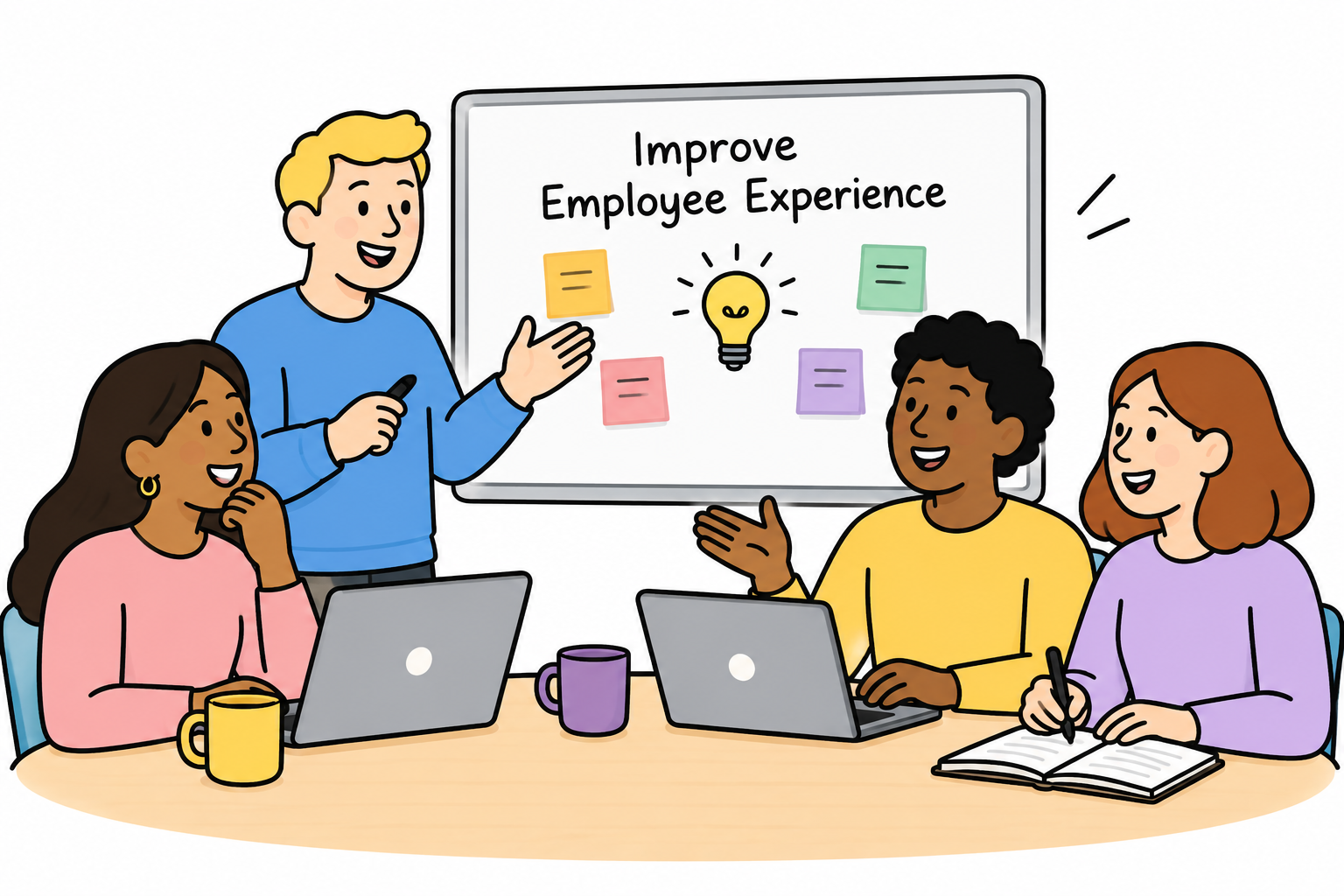

Culture is built on rhythm, a cadence that people expect and rely on. This is where they can reach a flow state and do their best work. Even when the workplace is a screen or three in their home office.
This can sound like a pretty utopian take on productivity when you're subject to burnout culture. It's even more maddening when management likes to see people "looking busy." But sincerely, it's not that out of reach. If you're catching up on recognition and engagement, you're already on the right path.
Today, we're not discussing the actions people take for a cash bonus. Nor are we examining how to reward high performers in hopes that others will work harder. We're learning how to sustainably increase employee productivity across the board through a culture that supports it.
What do we mean by employee productivity?
You're familiar with simple employee productivity calculations. Output vs. hours worked, completion rates, and yes, revenue per employee. It would be a bit extreme to call this "dehumanizing" because we need some of these measurements.
However, the kind of employee productivity we want to increase also positively impacts employee engagement and retention.
It's human employee productivity in a modern context:
- The amount of knowledge work that produces higher-quality output.
- Deep work that leverages human cognition to optimize and innovate.
- Staying virtually connected to amplify productivity through a sense of belonging.
- The ability to collaborate and own a place on a high-functioning team that keeps itself on track (with minimal intervention).
🙌 FACT: Employee productivity is so much more than hours spent.
Optimal productivity is a product. It's not a talent or a to-do-list task. It results from linking engagement and motivation through a healthier workplace culture. Beneficial cultures aren't just about supportive hand-holding and team-spirit chants. They are environments where goals and purpose are well-defined.
What's causing low productivity?
It's a day at work, not an evening at the theater. Yet the company often sets the stage for busy teams who don't get enough done. Here's why teams end up caught in productivity theater, looking busy without much meaningful output.
- Overemphasizing hours instead of examining results
- Distracting levels of gamification
- Too many programs, tools, and processes
- High workloads, long hours
- Ignoring work-life balance
- Poor attention to fundamentals like compensation, instructions, goals, and resources
The practices we'll share next take a deeper look at most of these causes and offer ways to correct them. However, the primary way to address cultural challenges spanning everything from well-being to meeting goals is recognition.
Employee recognition as the human-centered approach to increasing productivity
Recent research shows recognition's impact on productivity, among many other positive effects. This is where employee productivity becomes a human issue and not a metric to move.
Here's how productive, well-recognized employees perceive their workplaces:
- There's a sense of fairness and justice. Everyone is worthy of recognition, even for small contributions.
- They feel ownership over their work. Their employer recognizes them by allowing them autonomy and including them in decision-making.
- They feel like they belong. Recognition improves their job satisfaction, and they take pride in completing work for their employer.
Ready to make appreciation an everyday habit?
Try HeyTaco free for 30 days. No credit card required.
Try HeyTaco freeThe basics of recognition for productivity
We could go on for another 20 minutes about high-quality recognition. For now, here are the must-know qualities of recognition that specifically target performance.
- Highlights behaviors, not just output. When people are appreciated for it, they double down on these performance-enhancing behaviors.
- It's specific even when very small. Small, specific compliments within a positive feedback loop are believable and give people a chance to discover and capitalize on their strengths.
- Adds meaning to their tasks. Recognizing how their accuracy or improvement in a specific area affects the company makes it more personally meaningful.
📈 Higher engagement increases productivity by 17%. That's according to one study that examines recognition as the path toward higher engagement. Our comprehensive guide to employee engagement offers holistic strategies to improve every aspect of the workplace while boosting productivity.
How to increase employee productivity: Practices that naturally boost quality output
Recognition can start today. But to prove they mean it, organizations need to clear the way for higher productivity. This means examining, adjusting, or eradicating their own practices.
1. Eliminate obstacles.
Cut disruptions like too many meetings, micromanagement, and substandard tools and processes first.
- Cutting meetings. "This could have been an email," employees often remark. Do you think they might be right? Log weekly time spent in meetings. Evaluate the content of said meetings. Set and improve agendas, strengthen moderation, limit duration, and segment attendance by those who really need to be there.
- Replacing micromanagement with communication. We know check-ins matter, but when they're frequent, inconvenient, or unnecessary, they become a distraction. Emphasize clear expectations and communication over random helicoptering.
- Weeding inefficiencies out of workflows. Map out workflows and toss any redundancies or extra steps first. Create or update templates and SOPs to make processes more reliable and efficient. Replace tools that don't integrate seamlessly.
🤔 Do you trust your employees to do their jobs? Micromanagement and meandering meetings say otherwise. Learn more about building trust at work. Leaders who trust employees won't be as disruptive, and employees who trust leaders will flag what's hurting their productivity before the situation gets dire.
2. Protect their time and space.
Adopt asynchronous work practices, like individual communication over real-time interaction, company-wide for deep work blocks and focus time. For example, each morning contains a 90-minute deep work block from 9:30 am to 11 am.
During this time, we do not interact in any way that would ping a notification, and we do not schedule meetings. If we succeed with other key strategies listed here (particularly the next one), these 90 minutes will become a reliable source of daily productivity.
3. Clean up and clarify targets and goals.
We're all adults; we can identify what we need to work on and make a plan to get it done. However, do our plans align with everyone else's, especially our employer's? This is where many workplaces fail their teams.
- Weekly priorities. Use task management tools or simple lists to lay out what the week's output should include. Employees who start the week unsure what the next five to seven days will entail are less likely to be productive.
- Setting SMART goals. Yes, the old Specific, Measurable, Achievable, Relevant, and Time-bound trick. It should apply to all weekly priorities. This eliminates vague notions and time spent deliberating on what to do next.
- A framework for OKRs. If there's a specific objective employees should be meeting, state it plainly and define what outcomes help meet that objective. For instance, if the objective is to improve customer satisfaction scores, share how you'll do it, such as target percentages for ticket volume vs. productivity.
Finally, employees should be allowed to reject or defer tasks that aren't set as weekly priorities or don't support their current goals.
4. Extend training and resources beyond onboarding.
Many employees lack the training necessary to make the most of the tools they're given. They also lack consistent growth and learning opportunities that let them innovate or even improve. We often talk about this in terms of building employees' confidence and optimism about their future at a company.
The real issue is that a lack of proper resources and skill development creates fear, stress, and anxiety. Employees want to build their knowledge and efficiency so they can stay competitive as automation and AI advance. Training, mentorship, collaboration, and other opportunities increase productivity and retention.
Almost 50% of employees want these benefits, but don't know how to access them.
5. Respect rest, promote recovery.
Longer blocks of deep work aren't the best fit for every role or environment. Higher-pressure roles and crunch times before deadlines might benefit more from the Pomodoro technique. This adds more breaks to deep-focus sessions, reducing burnout while helping people beat procrastination.
Other ways to increase output with more frequent breaks include:
- Walking meetings or regular walking breaks
- Regular reminders encouraging employees to use their PTO
- Quiet rooms or areas where people can take a break to clear their minds
- A complete break for lunch, not just a time when people typically eat at their desks
🧘🏽 Wellness programs that promote rest and recovery can improve productivity. People who work while sick or stressed can't deliver their best. Learn more about building an employee wellness program that delivers health benefits, skill development, and a more centered, supportive culture at once.
6. Detox your monitoring processes.
When we're sweating productivity, the workplace can quickly become a surveillance state. Becoming Big Brother only makes the environment more toxic.
Don't create the hyperawareness of being watched. Knowing you're being tracked can increase output and also errors. Employees can become obsessed with doing more, leading to burnout. All because you wanted to measure productivity.
Looking for patterns and bottlenecks in processes should lead to potential solutions, not shaming. Employees shouldn't fear ending up at the bottom of a productivity graph during a meeting.
❓How do recognition tools help measure productivity? Peer recognition activity helps show how engaged an employee is. The more engaged, the more likely they are to do their best work. Learn more about HeyTaco Analytics and how this data provides actionable insights into team dynamics and other patterns of interest.
How do you increase employee productivity on remote and hybrid teams?
Many of the points and strategies presented today (especially recognition) benefit workers in a virtual environment. There shouldn't be many issues applying them. However, remote and hybrid teams face a unique challenge called productivity paranoia.
Maybe you're familiar with it. Productivity paranoia is when leaders and managers doubt their employees' productivity because they aren't watching them. That's despite studies showing remote workers are more efficient and productive than in-office workers, who face more distractions outside their control.
So, your first task with remote and hybrid productivity is to rule out paranoia. Someone isn't more productive because you saw their face. From there, the following principles can help us adjust strategies for remote workers:
1. Cut those meetings, but increase communication elsewhere.
Frequent check-ins and regular chat activity are more important on remote teams. You may feel that Zoom meetings help eliminate a leader's bias toward seeing faces, but they still drain time.
The bottom line is to touch base more often in smaller, yet still meaningful, ways. This is another strength of recognition tools.
2. Get into virtual collaboration and team-building.
Live coworking hours, shared-document collaboration, and virtual team rituals help connect remote and hybrid employees.
Building connections with coworkers, not just supervisors, helps with accountability. Familiarity and a better understanding of others' processes and responsibilities motivate remote workers to do their part.
Ready to make appreciation an everyday habit?
Try HeyTaco free for 30 days. No credit card required.
Try HeyTaco free3. Trust and output, not skepticism and surveillance.
Evidence from Gallup, Pew, Harvard, and Stanford shows that remote workers are productive. The problem is that they are less prone to truly connect, especially to a company without a healthy culture.
Therefore, adopt an attitude that remote and hybrid employees are to be trusted until proven otherwise. Put the quality and timeliness of their output before tracking tools and monitoring methods. A distrustful workplace that uses toxic surveillance practices is easier for remote employees to leave.
🌮 FACT: Remote teams rely on recognition tools to connect.🌮
Daily recognition in the team chat doesn't just work; it works really fast. Data analytics firm BSC Analytics uses HeyTaco to build traditions and enjoy positive interactions every day.
VP of People and Culture, Sam Reilley, says that if they didn't have HeyTaco, "I think I'd feel disconnected from the team almost immediately. HeyTaco empowers people daily and makes them feel heard, even if they're working remotely."
Your quick implementation guide to higher productivity in 2026
1. Foster engagement right away through recognition.
Use a cost-effective peer recognition tool that integrates with existing chat platforms to start building connections through gratitude ASAP. Here's how easy it is to launch HeyTaco this week.
2. Perform a deeply honest audit.
A temporary time tracker can reveal where most time goes. Review leadership, employee skill sets, and meeting time. Use feedback and surveys to assess how well employees understand goals and roles, and what distracts them.
3. Create your 30-day action plan.
Example: Week One can be the audit and other planning. Week Two can incorporate changes like fewer meetings, recognition tools, and distraction elimination. Week Three can introduce team rituals and clearer, broken-down communication of weekly tasks and goals. Week Four assesses and adjusts the results from the previous three weeks. (Be sure to celebrate ANY wins!)
4. Build toward 90-day milestones.
Example: Month One is acquiring tools, improving recognition and communication, and weeding out productivity killers. Month Two is about strengthening collaboration and refining workflows. Month Three is where rollouts for larger initiatives should now be underway, like additional training and learning opportunities and ways to improve work-life balance.
5. Measure (and celebrate) improvements.
Publicly celebrate weekly and monthly acknowledgments of improvements. Be specific and use data where possible. Also use hard data to maintain leadership buy-in. (Ex: "Cutting meeting time in half led to a 10% increase in met deadlines and a 13% increase in overall productivity.”)
6. Don't settle in. Sustain those gains.
Keep tracking KPIs, closing feedback loops, and holding managers accountable for skill drop-offs through consistent check-ins and effective communication.
7. Touch up tools and resources.
Review tools like task managers and the results of continuous learning initiatives. See which tools employees are using and accept feedback on their use to date.
Recognition makes everyone feel (and perform at) their best.
Productive employees are engaged employees first and foremost. Engaged employees build cohesive teams. Cohesive teams hold one another accountable for their contributions.
Recognition is at the root of it all: people feel seen and valued, even for the smallest things. It makes constructive feedback feel fair, not critical. It creates positive relationships that motivate us to achieve more, not check out.
Thousands of global teams use HeyTaco. Their results include:
- Higher engagement and morale
- Strong cross-department connections (even remotely!)
- A healthy, beneficial culturethat'ss built into their workflow, not a distraction"It'ss brought us closer together as a team, andthat'ss priceless. It also brings more awareness to whateveryone'ss doing, which is another big plus" –Steven B., QA Automation Engineer.
Learn more about how HeyTaco works and start your free trial this week.
Ready to make appreciation an everyday habit?
Try HeyTaco free for 30 days. No credit card required.
Try HeyTaco freeHow to increase employee productivity FAQ
What is the 333 rule for productivity?
This "rule" breaks your day into three three-hour blocks for better time management. Use three hours for deep work, three hours for high-priority tasks (especially those we procrastinate on), and three hours for maintenance tasks like emails and follow-up.
The 333 rule isn't right for every role or environment, but it can help you spend more time on deep work when productivity drops.
What are the most common causes of low employee productivity?
Unclear instructions, inadequate goal-setting, and other communication issues are often to blame. Overwork, busywork, a lack of appreciation, and insufficient resources are also known productivity killers.
How do you measure employee productivity?
The U.S. Bureau of Labor Statistics measures employee productivity by comparing their output to the hours worked. If you use this approach, focus on improving productivity rather than excessive monitoring.
Respect an employee's privacy and monitor discreetly. Putting surveillance up front can add pressure to a role and stress a worker beyond their limits.
Does having fun at work increase productivity?
Yes! Fun team rituals, frequent breaks, and shared humor have been shown to boost productivity, not distract from it. It reduces stress, increases engagement, and builds resilience-an employee's willingness to move forward and keep working toward goals.